

Wildlife Animals in Ranthambore National Park: Tigers, Leopards, and Birds
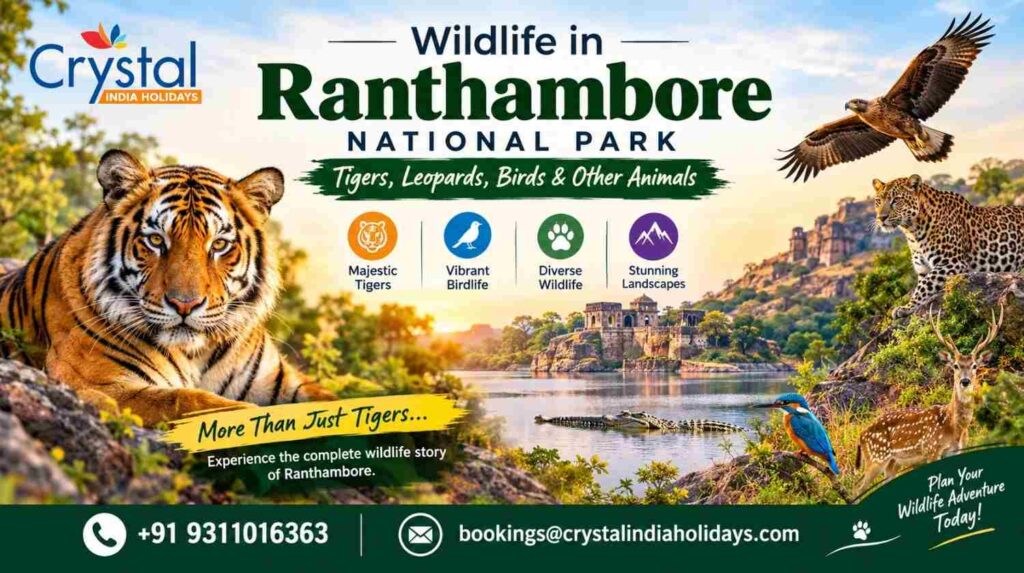
Wildlife animals in Ranthambore National Park is often reduced to one word – tigers – but the park supports a far wider range of species across dry deciduous forest, open grassland, rocky hills, and three major lakes. Leopards, sloth bears, marsh crocodiles, and well over 270 recorded bird species all share this landscape with Ranthambore’s Bengal tigers, and a safari here is genuinely shaped by all of them, not just the headline species.
We’ve guided guests through many safaris at Ranthambore, and some of the most memorable moments haven’t involved a tiger at all – a leopard slipping through the rocks at dusk, a crested serpent eagle circling over Rajbagh lake, or a marsh crocodile basking motionless at the edge of Padam Talao while langurs call out warnings from the trees above.
Wildlife in Ranthambore at a Glance
| Group | Examples |
| Big cats & predators | Bengal tiger, leopard, sloth bear, striped hyena, golden jackal, caracal |
| Herbivores & other mammals | Chital, sambar deer, nilgai, wild boar, Hanuman langur, rhesus macaque |
| Birds | Crested serpent eagle and other raptors, kingfishers, painted storks, peafowl, migratory waterbirds |
| Reptiles & aquatic wildlife | Marsh crocodile (mugger), monitor lizard, Indian rock python |
This is a starting reference, not a guarantee of what you’ll see on any single safari – sightings vary with season, zone, weather, and simple chance.
Why Is Ranthambore National Park Famous for Its Wildlife?
Ranthambore’s reputation rests on two things: a genuine tiger conservation recovery, and terrain that makes wildlife easier to observe than in many other Indian reserves.
The park became part of India’s Project Tiger network in 1974, one year after the national programme launched in response to a 1972 census that revealed how sharply India’s wild tiger population had collapsed. Since then, Ranthambore’s tiger numbers have recovered substantially from a low point in the early 2000s, though – as explained below – the exact current figure depends on which source and survey year you’re looking at.
Ranthambore’s dry deciduous forest and relatively open, rocky terrain also play a real role in sightings. Compared with the denser, moister forests of some other Indian tiger reserves, there’s simply less vegetation for animals to disappear into. This doesn’t guarantee a sighting on any given safari, but it does mean that when a tiger is active, visitors have a reasonably good chance of a clear, prolonged view rather than a brief glimpse through thick cover.
How Many Tigers Live in Ranthambore National Park?
The most recent widely cited official figure is 69 tigers, recorded in a 2022 count and referenced via Wikipedia’s sourcing of Indian wildlife media coverage. Some 2025–2026 wildlife tourism publications cite higher informal estimates, in the mid-to-high 70s, but these aren’t tied to a published government census and should be read as informal running estimates rather than official data.
A few things are worth understanding about why the numbers vary:
- India’s national tiger census is conducted roughly every four years by the National Tiger Conservation Authority (NTCA), using camera traps and pugmark analysis across India’s tiger reserves. Between official census years, any “current” figure you see is necessarily an estimate.
- Sources sometimes describe slightly different geographic boundaries – the national park’s core zone, the wider tiger reserve (which includes adjoining sanctuaries), and the broader “Ranthambore landscape” used in some conservation reporting aren’t always the same area, which can make population figures from different sources hard to compare directly.
- Numbers genuinely fluctuate with births, natural deaths, and the periodic relocation of individual tigers to other reserves as part of India’s broader tiger conservation and genetic-diversity programs.
If you need an exact, current figure for a specific purpose, we’d recommend checking the latest release from the Rajasthan Forest Department or the NTCA directly rather than relying on any single tourism article, including this one.
What is consistent across sources is the trend: Ranthambore’s tiger population has grown substantially since the early 2000s, a genuine conservation success story even where the precise current headcount is debated.
What Animals Can You See in Ranthambore Besides Tigers?
Tigers draw the crowds, but Ranthambore’s wider wildlife community is a significant part of what makes a safari here worthwhile – other big cats, a healthy herbivore population, strong birdlife, and a handful of reptiles that surprise many first-time visitors to a “tiger park.”
Big Cats and Other Predators in Ranthambore
- Leopards – present in the park but far more elusive than tigers. They generally favor rocky outcrops and denser cover, which is thought to help them avoid direct competition with tigers over similar prey; sightings are occasional rather than routine.
- Sloth bears – spotted from time to time, more often in the buffer zones than the core tourist zones. Sightings are considerably less predictable than tigers or leopards.
- Striped hyenas – largely nocturnal and rarely seen on daytime safaris, though present in the park’s quieter areas.
- Golden jackals – fairly commonly seen trotting across open grassland, particularly in early morning light.
- Caracals – among the rarest sightings reported in the park; a genuine bonus if you happen to see one.
Herbivores and Other Mammals in Ranthambore
The park’s herbivores aren’t just prey for its predators – they’re a large part of what makes a Ranthambore safari engaging even on a day without a tiger sighting.
- Chital (spotted deer) – the most frequently seen animal in the park, typically in herds across open grassland. Recognizable by their reddish-brown coat and white spots, retained into adulthood (unlike most deer species).
- Sambar deer – India’s largest deer species, often seen near water bodies, and an important part of the tiger’s prey base.
- Nilgai (blue bull) – common across the grasslands; adult males are easily identified by their larger size and blue-grey coat, while females and young are tan-brown.
- Wild boar – regularly seen foraging near forest edges, usually in small family groups.
- Hanuman langurs – their sharp alarm calls are often the first sign of a predator nearby, and experienced guides listen for this constantly. An alarm call is a useful clue, not a guarantee – langurs also call for other disturbances, so not every alarm leads to a sighting.
- Rhesus macaques – common throughout the park, especially near water sources.
Birds of Ranthambore National Park
Ranthambore has more than 270 recorded bird species, making it as much a destination for birdwatchers as for tiger safaris, even though this side of the park is often overlooked by visitors focused purely on tigers.
The park’s bird population breaks down roughly by habitat:
- Raptors, including crested serpent eagles – known for a distinctive, high-pitched call – often seen soaring above the lakes
- Waterbirds, including kingfishers (frequently near Padam Talao and Rajbagh) and painted storks, particularly visible during the winter migration period
- Resident species, including peafowl, present year-round and part of India’s national bird population
- Migratory species, which arrive in greater numbers during the winter months
Not every migratory species arrives at the same time, and sightings vary safari to safari – but winter (roughly November to February) is reliably the strongest window for serious birdwatching, when resident and migratory populations overlap.
Reptiles and Aquatic Wildlife in Ranthambore
Ranthambore’s lakes support a reptile population that catches many first-time visitors by surprise.
- Marsh crocodiles (muggers) – regularly seen basking along the banks of Padam Talao and Rajbagh, especially in the cooler morning hours. These are among the more reliable sightings in the park, given their limited mobility and preference for baking in direct sun.
- Monitor lizards – occasionally seen near rocky terrain and water edges; sightings are irregular rather than routine.
- Indian rock pythons – present in the park but rare to encounter, generally found in denser, quieter zones away from the main safari routes.
Wildlife by Habitat
Ranthambore’s varied terrain within a relatively compact area is a major reason it supports such a wide range of species. These are general habitat associations rather than fixed locations – animals move, and any individual safari depends on season, zone, and chance.
- Lakes and water edges (Padam Talao, Rajbagh, Malik Talao): marsh crocodiles, waterbirds, sambar deer, and – especially in hotter months – tigers drawn to water sources.
- Grasslands and open clearings: chital, nilgai, golden jackals, and ground-feeding birds.
- Rocky hills and outcrops: leopards, sloth bears, and monitor lizards, which favor cover and elevation away from the more open core-zone terrain.
- Forested areas: langurs, macaques, wild boar, and a range of resident birds, with denser cover offering more concealment than the grasslands.
What Makes Ranthambore’s Wildlife Habitat Unique?
Ranthambore sits where the Aravalli and Vindhya hill ranges meet, producing dry deciduous forest, open grassland, rocky hills, and three major lakes within a relatively compact 1,334 sq km area. This mix is largely why the park supports such a wide range of species in close proximity: grassland herbivores like chital and nilgai, rock-dwelling predators like leopards, water-dependent species like crocodiles and waterbirds, and tigers that move between zones depending on season and prey availability.
The park’s comparatively sparse vegetation – drier and more open than many of India’s other major tiger reserves – is also a meaningful factor in sightings, since there’s less dense cover for animals to disappear into. This doesn’t make Ranthambore universally “easier” than every other reserve, and it doesn’t guarantee a sighting on any individual safari, but it is a genuine structural reason behind the park’s reputation for good wildlife visibility.
What Is the Best Time to See Wildlife in Ranthambore?
The short answer: roughly March to June is strongest for tiger sightings, while November to February is strongest for birdwatching and general comfort.
- Summer (March–June): As temperatures climb and water becomes scarce, wildlife – including tigers – concentrates more predictably around the park’s remaining lakes and waterholes. This tends to be the strongest season for tiger sightings, despite the heat.
- Winter (November–February): Cooler, more comfortable safari conditions, plus the arrival of migratory bird species – the best combined window for general wildlife viewing and serious birdwatching.
- Monsoon (roughly July–September): Core zones close under forest department rules during this period; wildlife access is limited to whatever buffer-zone routes remain open that year. Exact dates can shift annually, so confirm current access before planning monsoon-season travel.
Across all seasons, actual sightings depend on weather, water availability, habitat conditions, the specific safari route assigned, and an element of chance that no guide or operator can eliminate. For a full month-by-month breakdown of weather and crowd levels, see our complete guide to the best time to visit Ranthambore.
Which Safari Zones Are Suitable for Wildlife Watching?
Ranthambore is divided into ten safari zones, split between core zones and buffer zones, and different zones tend to suit different kinds of wildlife – though none of this should be read as a guarantee.
| Wildlife | Zones commonly associated with sightings | Why |
| Tigers | Zones 1–5, especially near the lakes | Core zones sit closest to the main water bodies, where tiger territories tend to concentrate |
| Leopards | Rockier zones and adjoining buffer areas | Leopards favor denser, rockier cover away from core tiger territory |
| Migratory birds | Zones near Padam Talao and Rajbagh | Lake-adjacent zones draw the highest concentration of waterbirds in winter |
| Marsh crocodiles | Zones with lake frontage (1 and 2) | Regular presence around the park’s larger lakes |
| Sloth bears | Buffer zones | Lower safari traffic, which these more cautious animals tend to favor |
This table reflects general habitat tendencies reported by guides and operators, not a guaranteed outcome – animal movement, the specific route your vehicle takes, and the day’s conditions all affect what you actually see. Online safari bookings also don’t always let you choose your exact zone; allocation can be partly randomized through the general booking system, so even a well-researched preference doesn’t guarantee placement. For the full zone-by-zone breakdown and current booking process, see our Ranthambore safari booking and zones guide.
What to Expect During a Ranthambore Wildlife Safari
No safari anywhere can guarantee a tiger sighting, and it’s worth planning with that in mind rather than assuming one is certain. A single safari gives you a reasonable chance; many visitors who book two or three safaris across different zones and times of day report better overall results, though we don’t have measured statistics to quantify exactly how much the odds improve.
Even without a tiger sighting, a typical Ranthambore safari usually includes encounters with deer, langurs, and often birds of prey, set against the park’s lakes and scattered ruins – a genuinely worthwhile experience on its own, not a consolation prize.
What First-Time Visitors Should Know
A few practical points make a real difference for anyone on their first Ranthambore safari:
- A tiger sighting is never guaranteed. Go in planning to enjoy the broader wildlife and landscape, with a tiger sighting as a highlight rather than the sole measure of success.
- Zone and route access are set by the forest department and booking system, not by individual preference – your guide can request a zone, but placement isn’t always guaranteed.
- Book through official channels well ahead of travel, particularly for winter dates, and follow the booking instructions carefully (identification requirements, arrival times, permitted equipment).
- Dress for early starts and sun exposure – mornings can be cool, afternoons hot, and shade is limited inside the vehicle.
- Carry water and any permitted essentials according to current park rules, which can change, so check with your operator or the park before travel.
- Listen to your guide and stay quiet during sightings – this matters both for your own experience and for minimizing disturbance to the animals.
- Treat the safari as a full wildlife experience, not only a tiger search – the birdlife, herbivores, and landscape are genuinely worth your attention.
Before planning your safari, check our guide on how to reach Ranthambore National Park for details about nearby railway stations, road connections, and travel options.
Staying near the park can make early-morning safari planning easier. Explore our guide to Ranthambore National Park resorts and hotels to learn about accommodation options in the area.
Wildlife Photography Tips for Ranthambore National Park
- A phone camera can capture plenty of the overall safari experience, but a zoom lens of at least 200mm makes a real difference for wildlife close-ups, since distances to animals vary considerably.
- Keep your camera or phone ready and settings pre-adjusted before entering the park – wildlife moments are often brief.
- Listen for alarm calls from langurs and deer as an early cue, though not every alarm call leads to a sighting.
- Stay patient and quiet during an actual sighting; sudden movement or noise can end an encounter quickly.
- Early morning safaris generally offer softer light, better suited to photography than the harsher light of midday.
- Avoid flash photography on wildlife, particularly at close range, and follow your guide’s instructions on when photography is and isn’t appropriate.
You don’t need expensive equipment to enjoy a Ranthambore safari – many visitors get excellent memories and reasonable photos with nothing more than a phone and a bit of patience.
Responsible Wildlife Viewing and Safari Etiquette
Respectful safari conduct protects both your experience and the park’s wildlife:
- Follow your guide’s and the forest department’s instructions at all times.
- Stay on authorized safari routes – never ask your driver or guide to leave the designated track or approach an animal more closely than permitted.
- Keep noise low, particularly during a sighting; sudden sound can disturb animals and shorten the encounter for everyone in the vehicle.
- Never feed or attempt to provoke wildlife.
- Respect the space of other safari vehicles sharing a sighting.
- Follow current photography and safety rules, which can vary by zone and season – check with your operator before travel rather than assuming general safari etiquette covers every park-specific rule.
Wildlife Conservation and Visitor Responsibility
Ranthambore’s recovery from a low tiger population in the early 2000s to its current numbers reflects decades of anti-poaching enforcement, habitat protection, and conservation work coordinated through Project Tiger and the National Tiger Conservation Authority. Responsible tourism plays a genuine supporting role in this – park entry fees and permits fund conservation and forest department operations, and visitors who follow safari rules and guide instructions reduce disturbance to wildlife and habitat.
We don’t claim any specific conservation partnership or measurable conservation impact as a company; our role is to help visitors safari responsibly and understand the rules that protect the park they’ve come to see.
Plan Your Ranthambore Wildlife Experience with Crystal India Holidays
We help guests plan realistic, well-timed Ranthambore safaris – advising on season, zone preferences (within what official booking allows), and how many safaris make sense for your travel dates. Whether you’re adding Ranthambore to a Golden Triangle Tour with Ranthambore or planning it as a dedicated wildlife trip, we handle the booking logistics, transport, and stay so you can focus on the experience itself.
Planning a wildlife experience in Rajasthan? Explore our Ranthambore tour options or contact Crystal India Holidays to discuss a private itinerary based on your travel dates and interests.
Frequently Asked Questions
1. What wildlife is Ranthambore National Park famous for?
Ranthambore is best known for its Royal Bengal Tigers, which are comparatively easy to observe thanks to the park’s open, dry terrain, alongside leopards, sloth bears, and a strong bird population.
2. What animals can visitors see besides tigers?
Leopards, sloth bears, striped hyenas, golden jackals, chital, sambar deer, nilgai, marsh crocodiles, and over 270 recorded bird species.
3. Are leopards found in Ranthambore?
Yes, though they’re far more elusive than tigers and mostly seen in rockier, denser-cover zones away from core tiger territory.
4. Can visitors see crocodiles in Ranthambore?
Yes – marsh crocodiles are regularly seen basking along Padam Talao and Rajbagh, particularly in the cooler morning hours.
5. How many tigers live in Ranthambore?
The most recent widely cited figure is 69 tigers (2022 count); some 2025–2026 estimates suggest the number has grown since, though these aren’t tied to a published official census. Check the latest Rajasthan Forest Department or NTCA release for a current figure.
6. What is the best season for wildlife viewing?
Roughly March to June offers the strongest tiger sighting conditions, while November to February is strongest for birdwatching and general comfort.
7. Which birds can visitors see in Ranthambore?
Raptors such as crested serpent eagles, waterbirds including kingfishers and painted storks, resident peafowl, and a range of migratory species that arrive mainly in winter.
8. Are tiger sightings guaranteed?
No. No safari anywhere can guarantee a specific sighting. Many visitors who book multiple safaris across different zones report better overall results.
9. How many safaris should a first-time visitor consider?
There’s no fixed number, but two or three safaris across different zones and times of day give you more opportunities than a single outing, at the cost of additional time and expense.
10. What should visitors know before their first safari?
Sightings aren’t guaranteed, zone allocation isn’t always within your control, and the experience is worth planning around the broader wildlife and landscape – not a tiger sighting alone.
Conclusion
Ranthambore’s tigers rightly draw travelers from around the world, but the park’s leopards, bears, birds, and reptiles round out a wildlife experience that goes well beyond a single species. Understanding the park’s habitats, realistic sighting expectations, and safari etiquette helps turn a Ranthambore trip into a genuinely well-informed one, whatever you end up seeing on the day.
Planning a wildlife experience in Rajasthan? Explore our Ranthambore tour options or contact Crystal India Holidays to discuss a private itinerary based on your travel dates and interests.