

12 Jyotirlinga Name and Place in India: Complete List with Locations and States
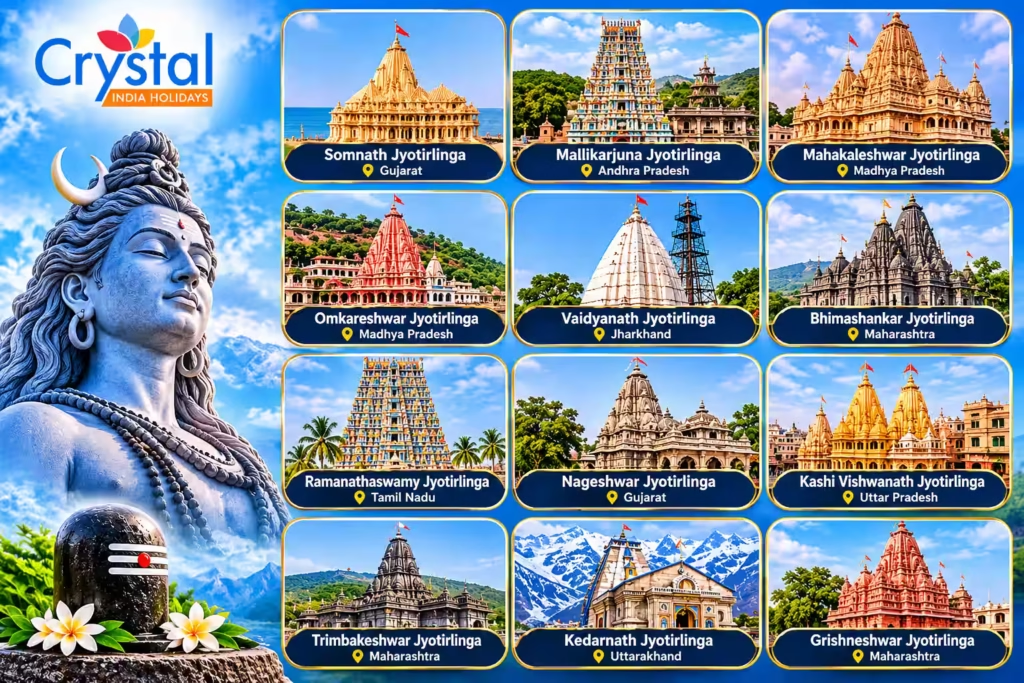
Quick answer: The 12 Jyotirlingas are Somnath, Mallikarjuna, Mahakaleshwar, Omkareshwar, Vaidyanath, Bhimashankar, Ramanathaswamy, Nageshwar, Kashi Vishwanath, Trimbakeshwar, Kedarnath and Grishneshwar. These sacred Lord Shiva temples stand across nine Indian states, from Kedarnath in the Himalayas to Rameswaram on the southern coast.
One temple watches over the Arabian Sea. Another sits on a river island shaped like “Om”. A third waits at 3,583 metres, reachable only on foot, by pony or by helicopter. The twelve Jyotirlingas span almost every landscape India has, and each asks something different of the pilgrim.
This guide gives you the complete 12 Jyotirlinga name and place list, along with darshan timings, how to reach each temple, the best season to visit and practical tips for planning your Jyotirlinga yatra.
Table of Contents
- 1. What Is a Jyotirlinga?
- 2. 12 Jyotirlinga Name and Place List
-
3. 12 Jyotirlingas: Temple-by-Temple Guide
- 3.1 Somnath Jyotirlinga, Gujarat
- 3.2 Mallikarjuna Jyotirlinga, Andhra Pradesh
- 3.3 Mahakaleshwar Jyotirlinga, Madhya Pradesh
- 3.4 Omkareshwar Jyotirlinga, Madhya Pradesh
- 3.5 Vaidyanath Jyotirlinga, Jharkhand
- 3.6 Bhimashankar Jyotirlinga, Maharashtra
- 3.7 Ramanathaswamy Jyotirlinga, Tamil Nadu
- 3.8 Nageshwar Jyotirlinga, Gujarat
- 3.9 Kashi Vishwanath Jyotirlinga, Uttar Pradesh
- 3.10 Trimbakeshwar Jyotirlinga, Maharashtra
- 3.11 Kedarnath Jyotirlinga, Uttarakhand
- 3.12 Grishneshwar Jyotirlinga, Maharashtra
- 4. Alternate Jyotirlinga Sites in Regional Traditions
- 6. Frequently Asked Questions
- 7. Conclusion
What Is a Jyotirlinga?
A Jyotirlinga is a shrine where devotees worship Lord Shiva as a jyoti, a radiant column of light. The word joins jyoti (light) and linga (Shiva’s symbolic form).
The Shiva Purana explains its origin. Brahma and Vishnu once argued over who was supreme. To settle the dispute, Shiva appeared between them as an endless pillar of fire. Vishnu dived downward and Brahma soared upward, but neither found its end. The places linked to this divine appearance became the Jyotirlingas.
Jyotirlinga vs Shivling: Every Shiva temple holds a Shivling, but only these twelve shrines carry Jyotirlinga status. Devotees believe Shiva manifested himself at these exact spots, so they hold a special place in Hindu pilgrimage.
The Dwadasha Jyotirlinga Stotram, a Sanskrit hymn attributed to Adi Shankaracharya, names all twelve in a set order. Devotees recite it daily, and this guide follows the same sequence.
12 Jyotirlinga Name and Place List
| No. | Jyotirlinga | Place | State | Nearest Airport | Best Time |
|---|---|---|---|---|---|
| 1 | Somnath | Prabhas Patan, near Veraval | Gujarat | Diu (approx. 85 km) | October – March |
| 2 | Mallikarjuna | Srisailam | Andhra Pradesh | Hyderabad (approx. 215 km) | October – February |
| 3 | Mahakaleshwar | Ujjain | Madhya Pradesh | Indore (approx. 55 km) | October – March |
| 4 | Omkareshwar | Mandhata Island, Narmada River | Madhya Pradesh | Indore (approx. 80 km) | October – March |
| 5 | Vaidyanath | Deoghar | Jharkhand | Deoghar (approx. 10 km) | October – March |
| 6 | Bhimashankar | Sahyadri Hills, Pune district | Maharashtra | Pune (approx. 110 km) | July – February |
| 7 | Ramanathaswamy | Rameswaram | Tamil Nadu | Madurai (approx. 175 km) | October – April |
| 8 | Nageshwar | Near Dwarka | Gujarat | Jamnagar (approx. 140 km) | October – March |
| 9 | Kashi Vishwanath | Varanasi | Uttar Pradesh | Varanasi (approx. 25 km) | October – March |
| 10 | Trimbakeshwar | Trimbak, near Nashik | Maharashtra | Nashik (approx. 55 km) | October – March |
| 11 | Kedarnath | Rudraprayag district, Himalayas | Uttarakhand | Dehradun (approx. 240 km to Gaurikund) | May – June, September – October |
| 12 | Grishneshwar | Verul, near Ellora Caves | Maharashtra | Chhatrapati Sambhajinagar (approx. 35 km) | October – March |
Distances are approximate and depend on your route.
12 Jyotirlingas: Temple-by-Temple Guide
1. Somnath Jyotirlinga, Gujarat
Tradition counts Somnath as the first Jyotirlinga. The temple stands at Prabhas Patan, where the waves of the Arabian Sea roll in almost at its walls. Invaders destroyed the shrine several times over the centuries, and each time devotees rebuilt it. The present Chalukya-style temple, completed in 1951, symbolises that resilience. In the evening, a light-and-sound show retells its history against the sea.
| Detail | Information |
|---|---|
| Location | Prabhas Patan, near Veraval, Gir Somnath district |
| Nearest Airport | Diu (approx. 85 km); Rajkot for more flights |
| Nearest Railway Station | Veraval (approx. 7 km) |
| Darshan Timings | 6:00 AM – 10:00 PM |
| Temple Open | Year-round |
| Best Time to Visit | October – March |
| Key Ritual / Festival | Aartis at 7:00 AM, 12:00 noon and 7:00 PM; Mahashivratri |
| Nearby Places | Triveni Sangam, Bhalka Tirth, Somnath Beach |
| Visitor Tip | Mobiles and cameras aren’t allowed inside; use the free cloakroom. The light-and-sound show runs 8:00 – 9:00 PM (not in the monsoon). |
2. Mallikarjuna Jyotirlinga, Andhra Pradesh
Mallikarjuna crowns the Srisailam hill in the Nallamala forest, high above the Krishna River. It holds a rare double status: devotees worship Shiva here as Mallikarjuna and Parvati as Goddess Bhramaramba, making it both a Jyotirlinga and a Shakti Peetha. The approach road runs through the Nagarjunasagar-Srisailam Tiger Reserve, so the forest drive becomes part of the pilgrimage itself.
| Detail | Information |
|---|---|
| Location | Srisailam, Nandyal district |
| Nearest Airport | Hyderabad (approx. 215 km) |
| Nearest Railway Station | Markapur Road (approx. 85 km) |
| Darshan Timings | Approx. 4:30 AM – 10:00 PM, with breaks for rituals |
| Temple Open | Year-round |
| Best Time to Visit | October – February |
| Key Ritual / Festival | Mahashivratri Brahmotsavam |
| Nearby Places | Srisailam Dam, Patala Ganga, Akkamahadevi Caves |
| Visitor Tip | Forest checkposts restrict night travel, so plan the drive in daylight. |
3. Mahakaleshwar Jyotirlinga, Madhya Pradesh
Mahakaleshwar in Ujjain is the only south-facing (Dakshinamukhi) Jyotirlinga, a direction linked to Shiva as Mahakal, the lord of time and death. Its most famous ritual is the Bhasma Aarti, which priests perform before dawn using sacred ash. The new Mahakal Lok corridor, lined with murals and statues, now leads devotees toward the temple.
| Detail | Information |
|---|---|
| Location | Ujjain, on the banks of the Shipra River |
| Nearest Airport | Indore (approx. 55 km) |
| Nearest Railway Station | Ujjain Junction (approx. 2 km) |
| Darshan Timings | Approx. 4:00 AM – 11:00 PM |
| Temple Open | Year-round |
| Best Time to Visit | October – March |
| Key Ritual / Festival | Bhasma Aarti (approx. 4:00 – 6:00 AM); Mahashivratri; Shravan |
| Nearby Places | Mahakal Lok, Kal Bhairav Temple, Harsiddhi Temple, Ram Ghat |
| Visitor Tip | Attending the Bhasma Aarti requires an advance pass from the temple’s official website, and a traditional dress code applies. |
4. Omkareshwar Jyotirlinga, Madhya Pradesh
Omkareshwar sits on Mandhata Island, where the Narmada River curves around land shaped like the sacred symbol “Om”. Pilgrims usually visit Mamaleshwar on the opposite bank too, since many traditions treat both shrines as one Jyotirlinga. The 108-foot Statue of Oneness, honouring Adi Shankaracharya, now overlooks the island.
| Detail | Information |
|---|---|
| Location | Mandhata Island, Khandwa district |
| Nearest Airport | Indore (approx. 80 km) |
| Nearest Railway Station | Omkareshwar Road (approx. 12 km) |
| Darshan Timings | Approx. 5:00 AM – 10:00 PM, with a midday break |
| Temple Open | Year-round |
| Best Time to Visit | October – March |
| Key Ritual / Festival | Narmada parikrama; Kartik Purnima; Mahashivratri |
| Nearby Places | Mamaleshwar Temple, Statue of Oneness, Siddhnath Temple |
| Visitor Tip | Take a boat across the Narmada for the best view of the island. |
5. Vaidyanath Jyotirlinga, Jharkhand
Baba Baidyanath Dham in Deoghar honours Shiva as the divine healer. Devotees also count it among the Shakti Peethas. Every Shravan month, lakhs of kanwariyas walk about 105 km from Sultanganj carrying Ganga water to pour on the lingam, which makes the Shravani Mela one of India’s largest annual pilgrimages.
| Detail | Information |
|---|---|
| Location | Deoghar, Santhal Pargana |
| Nearest Airport | Deoghar (approx. 10 km) |
| Nearest Railway Station | Jasidih Junction (approx. 7 km) |
| Darshan Timings | Approx. 4:00 AM – 3:30 PM and 6:00 PM – 9:00 PM |
| Temple Open | Year-round |
| Best Time to Visit | October – March |
| Key Ritual / Festival | Shravani Mela (July – August); Mahashivratri |
| Nearby Places | Basukinath Temple, Trikut Parvat, Naulakha Mandir |
| Visitor Tip | Visit outside Shravan if you want a calmer darshan. |
6. Bhimashankar Jyotirlinga, Maharashtra
Bhimashankar hides deep in the forested Sahyadri hills, inside a wildlife sanctuary that protects the Indian giant squirrel, Maharashtra’s state animal. The Bhima River rises here. Its Nagara-style stone temple, surrounded by mist for much of the monsoon, gives pilgrims a calm, nature-filled darshan unlike the busy city temples.
| Detail | Information |
|---|---|
| Location | Bhorgiri village, Pune district |
| Nearest Airport | Pune (approx. 110 km) |
| Nearest Railway Station | Pune Junction (approx. 110 km) |
| Darshan Timings | Approx. 4:30 AM – 9:30 PM |
| Temple Open | Year-round |
| Best Time to Visit | July – February |
| Key Ritual / Festival | Mahashivratri; Shravan Mondays |
| Nearby Places | Bhimashankar Wildlife Sanctuary, Gupt Bhimashankar, Hanuman Lake |
| Visitor Tip | Monsoon brings waterfalls but slippery steps, so wear sturdy footwear. |
7. Ramanathaswamy Jyotirlinga, Tamil Nadu
According to the Ramayana, Lord Rama worshipped Shiva at Rameswaram before crossing the sea to Lanka. The temple impresses visitors with its pillared corridors, among the longest in India. Before darshan, pilgrims bathe in the 22 sacred wells (theerthams) inside the complex. Rameswaram is also one of the four Char Dham sites.
| Detail | Information |
|---|---|
| Location | Rameswaram Island, Ramanathapuram district |
| Nearest Airport | Madurai (approx. 175 km) |
| Nearest Railway Station | Rameswaram (approx. 1 km) |
| Darshan Timings | Approx. 5:00 AM – 1:00 PM and 3:00 PM – 9:00 PM |
| Temple Open | Year-round |
| Best Time to Visit | October – April |
| Key Ritual / Festival | Bath in the 22 theerthams; Mahashivratri |
| Nearby Places | Agni Theertham, Dhanushkodi, Pamban Bridge, Dr APJ Abdul Kalam Memorial |
| Visitor Tip | Carry a spare set of clothes for the theertham bath. |
8. Nageshwar Jyotirlinga, Gujarat
Nageshwar stands on the road between Dwarka and Bet Dwarka on Gujarat’s Saurashtra coast. Devotees worship Shiva here as the protector from all poisons, both physical and spiritual. A large seated Shiva statue outside the temple greets visitors from a distance. Most pilgrims pair it with the Dwarkadhish Temple, one of the Char Dham sites.
| Detail | Information |
|---|---|
| Location | Daarukavanam, near Dwarka, Devbhumi Dwarka district |
| Nearest Airport | Jamnagar (approx. 140 km) |
| Nearest Railway Station | Dwarka (approx. 17 km) |
| Darshan Timings | Approx. 6:00 AM – 12:30 PM and 5:00 PM – 9:00 PM |
| Temple Open | Year-round |
| Best Time to Visit | October – March |
| Key Ritual / Festival | Mahashivratri |
| Nearby Places | Dwarkadhish Temple, Bet Dwarka, Rukmini Devi Temple, Sudarshan Setu |
| Visitor Tip | Combine it with Somnath for a complete Saurashtra coastal circuit. |
9. Kashi Vishwanath Jyotirlinga, Uttar Pradesh
Kashi Vishwanath in Varanasi ranks among Hinduism’s holiest shrines, and devotees believe Shiva grants liberation (moksha) in this city. The Kashi Vishwanath Dham corridor now connects the temple directly to the Ganga ghats. Each day begins with the Mangla Aarti before dawn, and many pilgrims end it at the Ganga Aarti on Dashashwamedh Ghat.
| Detail | Information |
|---|---|
| Location | Vishwanath Gali, Varanasi, on the Ganga |
| Nearest Airport | Varanasi (approx. 25 km) |
| Nearest Railway Station | Varanasi Junction (approx. 5 km) |
| Darshan Timings | Temple open 3:00 AM – 11:00 PM; darshan 4:00 – 11:00 AM, 12:20 – 7:00 PM and 8:30 – 9:00 PM |
| Temple Open | Year-round |
| Best Time to Visit | October – March |
| Key Ritual / Festival | Mangla Aarti (3:00 – 4:00 AM); Mahashivratri; Dev Deepawali |
| Nearby Places | Dashashwamedh Ghat, Kaal Bhairav Temple, Sarnath |
| Visitor Tip | Phones, gadgets and even pens aren’t allowed inside, so use the lockers. |
10. Trimbakeshwar Jyotirlinga, Maharashtra
Trimbakeshwar’s lingam is unique: it has three small faces representing Brahma, Vishnu and Shiva. The Godavari River rises on the Brahmagiri hill just above the temple. Families travel here for rituals such as Narayan Nagbali and Kaal Sarp puja, and the town co-hosts the Simhastha Kumbh Mela with Nashik.
| Detail | Information |
|---|---|
| Location | Trimbak, Nashik district |
| Nearest Airport | Nashik/Ozar (approx. 55 km); Mumbai (approx. 180 km) |
| Nearest Railway Station | Nashik Road (approx. 40 km) |
| Darshan Timings | Approx. 5:30 AM – 9:00 PM |
| Temple Open | Year-round |
| Best Time to Visit | October – March |
| Key Ritual / Festival | Narayan Nagbali, Kaal Sarp puja; Simhastha Kumbh Mela |
| Nearby Places | Brahmagiri hill, Kushavarta Kund, Anjaneri |
| Visitor Tip | Mondays and weekends draw big crowds; a weekday morning is quieter. |
11. Kedarnath Jyotirlinga, Uttarakhand
At about 3,583 metres in the Garhwal Himalayas, Kedarnath is the highest Jyotirlinga and a key stop on the Char Dham Yatra. Its massive stone temple survived the 2013 floods almost untouched, shielded by a boulder that devotees now revere as Bhim Shila. Snow closes the shrine each winter, when priests carry the deity to Omkareshwar Temple in Ukhimath for winter worship.
| Detail | Information |
|---|---|
| Location | Rudraprayag district, near the Mandakini River |
| Nearest Airport | Dehradun Jolly Grant (approx. 240 km to Gaurikund) |
| Nearest Railway Station | Rishikesh (approx. 210 km to Gaurikund) |
| Darshan Timings | Approx. 6:00 AM – 3:00 PM and 5:00 PM – 9:00 PM (in season) |
| Temple Open | Seasonal: roughly late April/May to around Bhai Dooj (Oct – Nov) |
| Best Time to Visit | May – June, September – October |
| Key Ritual / Festival | Opening and closing ceremonies of the temple doors |
| Nearby Places | Bhairavnath Temple, Vasuki Tal, Gandhi Sarovar |
| Visitor Tip | The trek from Gaurikund covers 16 – 18 km. Online yatra registration with the Uttarakhand government is mandatory. |
For route options, read our guide on [How to Reach Kedarnath from Delhi].
12. Grishneshwar Jyotirlinga, Maharashtra
Grishneshwar, the smallest of the twelve, stands in Verul village, barely 1.5 km from the Ellora Caves. Its red basalt walls carry fine carvings of gods and mythological scenes. Queen Ahilyabai Holkar rebuilt the temple in the 18th century, the same ruler who restored Kashi Vishwanath and Somnath.
| Detail | Information |
|---|---|
| Location | Verul, Chhatrapati Sambhajinagar district |
| Nearest Airport | Chhatrapati Sambhajinagar (approx. 35 km) |
| Nearest Railway Station | Chhatrapati Sambhajinagar (approx. 30 km) |
| Darshan Timings | Approx. 5:30 AM – 9:30 PM |
| Temple Open | Year-round |
| Best Time to Visit | October – March |
| Key Ritual / Festival | Mahashivratri; Shravan Mondays |
| Nearby Places | Ellora Caves, Daulatabad Fort, Bibi Ka Maqbara |
| Visitor Tip | Men remove shirts and vests before entering the sanctum. Ellora Caves close on Tuesdays. |
Alternate Jyotirlinga Sites in Regional Traditions
Searching for the 12 Jyotirlinga names may show two or three different temples for the same name. This happens because regional traditions interpret the scriptures differently. All of these temples are active, revered places of worship.
- Vaidyanath: Most devotees honour Baidyanath Dham in Deoghar, Jharkhand. A strong Maharashtra tradition worships Parli Vaijnath in Beed district instead.
- Nageshwar: Gujarat’s temple near Dwarka is the most widely visited. Others identify the Jyotirlinga with Aundha Nagnath in Maharashtra or Jageshwar in Uttarakhand’s Almora district.
- Bhimashankar: Maharashtra’s Sahyadri shrine is the standard choice, while a smaller tradition places it near Guwahati in Assam.
Pilgrims usually follow the tradition of their family or guru.
How to Plan a 12 Jyotirlinga Yatra
Region-Wise Jyotirlinga Circuits
The shrines stretch about 3,000 km from north to south, so few pilgrims cover all twelve in one go. Grouping them by region saves time and energy.
| Circuit | Jyotirlingas | Base City | Suggested Days |
|---|---|---|---|
| Madhya Pradesh | Mahakaleshwar, Omkareshwar | Indore | 2 – 3 |
| Gujarat | Somnath, Nageshwar | Rajkot / Jamnagar | 3 – 4 |
| Maharashtra | Trimbakeshwar, Grishneshwar, Bhimashankar | Mumbai / Pune | 4 – 5 |
| Himalayan | Kedarnath | Delhi / Haridwar | 5 – 6 |
| East | Kashi Vishwanath, Vaidyanath | Varanasi | 3 – 4 |
| South | Mallikarjuna, Ramanathaswamy | Hyderabad / Madurai | 2 – 3 each |
How Many Days Do You Need for All 12?
Plan around 22 – 28 days if you cover all twelve in one long journey with flights between regions. Most pilgrims instead complete one or two circuits per trip, spreading the full yatra across a year or more.
Best Time and Festivals
October to March suits most temples, with cooler weather for queues and walking. Kedarnath is the exception: it opens only in its summer season, and the July – August monsoon makes the mountain route risky.
Two periods change the experience completely. Mahashivratri (February – March) brings special rituals and night-long worship, along with huge crowds. Shravan (July – August) is Shiva’s holiest month, when queues at Deoghar, Ujjain and Varanasi can stretch for hours. Choose these dates for devotion, and avoid them if you want a quick darshan.
Practical Tips for Pilgrims
- Dress modestly. Several temples ask devotees to avoid shorts and short skirts, and some set traditional dress rules for the sanctum.
- Carry ID. Temples ask for it for aarti passes, special darshan and Kedarnath registration.
- Leave gadgets behind. Somnath and Kashi Vishwanath don’t allow phones or cameras inside, and both provide lockers.
- Start early. Morning darshan usually means shorter queues and cooler weather.
- Pace yourself. Senior travellers should keep road days short and, for Kedarnath, consider a pony, palki or helicopter.
- Check official updates. Temple trusts change timings during festivals and seasons.
Frequently Asked Questions
1. Which is the first Jyotirlinga?
Somnath in Gujarat is traditionally the first Jyotirlinga, and the Dwadasha Jyotirlinga Stotram names it first.
2. Which is the most powerful Jyotirlinga?
Hindu scriptures don’t rank the Jyotirlingas; each one represents the same divine light of Shiva. Devotees often feel a special connection to particular shrines, such as Mahakaleshwar for its Bhasma Aarti or Kashi Vishwanath for its link to moksha.
3. Which Jyotirlinga is the hardest to reach?
Kedarnath. It requires a 16 – 18 km mountain trek from Gaurikund (or a pony, palki or helicopter), and it opens only for part of the year.
4. Which Jyotirlinga faces south?
Mahakaleshwar in Ujjain is the only south-facing (Dakshinamukhi) Jyotirlinga.
5. Which state has the most Jyotirlingas?
Maharashtra, with three: Trimbakeshwar, Bhimashankar and Grishneshwar. Gujarat and Madhya Pradesh have two each.
6. Are mobile phones allowed inside Jyotirlinga temples?
Not in all of them. Somnath and Kashi Vishwanath prohibit phones, cameras and other gadgets inside and provide lockers. Rules vary, so check each temple before you visit.
7. Is there an entry fee for Jyotirlinga darshan?
General darshan is free at the Jyotirlinga temples. Some temples offer paid options, such as special darshan or aarti passes.
8. What should I wear to a Jyotirlinga temple?
Wear modest clothes that cover your shoulders and knees. Some temples set stricter rules: Grishneshwar asks men to remove shirts in the sanctum, and the Bhasma Aarti at Mahakaleshwar requires traditional dress.
9. Can non-Hindus visit the Jyotirlinga temples?
Rules differ by temple. Somnath, for example, requires non-Hindu visitors to take prior permission from the temple trust. Contact the temple trust directly before you plan a visit.
10. Can I visit all 12 Jyotirlingas in one trip?
You can, but it takes around 22 – 28 days with flights between regions. Most pilgrims complete the yatra in stages, one regional circuit at a time.
Conclusion
The twelve Jyotirlingas take you through the sea coast of Saurashtra, the forests of the Sahyadris, the ghats of Varanasi and the high Himalayas. Each shrine carries its own legend, rituals and rhythm. Start with one regional circuit, check the latest timings before you travel, and give every darshan the time it deserves. Let Crystal India Holidays help you plan a meaningful journey through India’s sacred destinations.