

How to Reach Kedarnath from Delhi: Complete Travel Guide
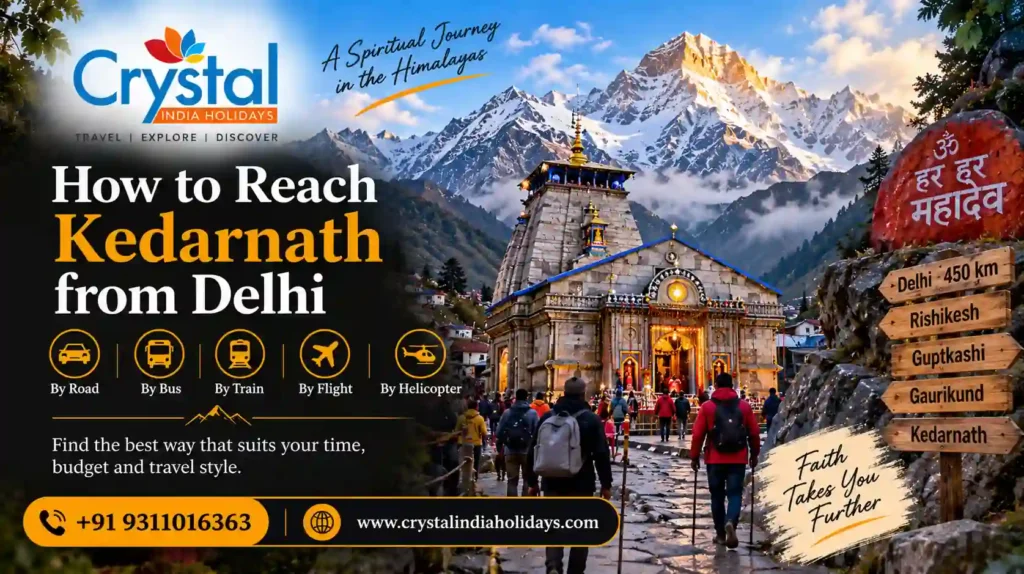
Kedarnath sits at 3,583 metres in the Garhwal Himalayas, and no road goes all the way there. Every route from Delhi – whether you fly, drive, take a bus, or catch a train – eventually ends at Gaurikund, where the only way forward is on foot, by pony, or by helicopter.
This guide by Crystal India Holidays covers every real way to reach Kedarnath from Delhi, with honest distances, costs, and timings for each, plus the registration rules, the trek itself, and the practical details that decide whether your journey goes smoothly or turns into a scramble. By the end, you’ll know exactly which option fits your trip – not just which options exist.
Quick Facts
| Road distance (Delhi to Gaurikund) | Approximately 450 km |
| Trek distance | Gaurikund to Kedarnath, about 16-18 km |
| Road travel time | 12-14 hours, usually split over 2 days |
| Trek time | 6-8 hours, depending on fitness and pace |
| Fastest option | Flight to Dehradun + helicopter from Phata/Sersi (a few hours in the air, though the full trip including road transfers still takes most of a day) |
| Cheapest option | State-run bus to Haridwar/Rishikesh, then bus or shared taxi onward |
| Nearest airport | Jolly Grant Airport, Dehradun (about 238 km from Kedarnath) |
| Direct train | None – nearest usable stations are Haridwar and Rishikesh |
| Registration | Biometric registration is mandatory for every pilgrim |
| Temple open season | Roughly late April/May to November; closed in winter |
Which Option Fits Your Trip?
Most guides list the transport options and leave you to figure out which one actually suits you. Here’s that decision made concrete:
| If you are… | Best option | Why |
| Short on time (long weekend only) | Flight to Dehradun + helicopter from Phata/Sersi | Cuts the 12+ hour road journey down to a few hours of transfers and a short flight |
| Elderly or have limited mobility | Flight + helicopter, or road + pony/palki for the trek | Avoids the 16-18 km trek on foot entirely |
| Traveling on a tight budget | State bus to Haridwar/Rishikesh, then local bus or shared taxi | Cheapest way to cover the distance, even though it takes longest |
| A family with children | Private car or taxi, with an overnight halt at Guptkashi or Sonprayag | Flexibility to stop, rest, and set your own pace |
| Traveling solo and want comfort without the cost of a flight | Volvo or private bus from Delhi to Rishikesh, then onward transport | Comfortable seating for the long stretch, at a fraction of flight or helicopter cost |
| Fit, time-rich, and want the full pilgrimage experience | Self-drive or private taxi to Sonprayag, then the full trek on foot | The traditional route – slower, but it’s the journey most pilgrims associate with the yatra |
There’s no universally “best” way to reach Kedarnath – only the one that fits your time, budget, and physical comfort.
By Road: The Complete Route
The standard route from Delhi to Kedarnath runs:
Delhi → Haridwar → Rishikesh → Devprayag → Srinagar → Rudraprayag → Guptkashi → Sonprayag → Gaurikund
Your vehicle can only go as far as Sonprayag. From there, a local shuttle or shared jeep covers the last 5 km to Gaurikund, where the trek begins.
Stage-by-stage breakdown:
| Stage | Approx. distance | Approx. time | Notes |
| Delhi to Haridwar | 220-230 km | 5-6 hours | Smooth 4-lane highway |
| Haridwar to Rishikesh | 25 km | 45 min-1 hour | Short, easy stretch |
| Rishikesh to Rudraprayag | 140 km | 4-5 hours | Road enters the hills; more curves, slower speeds |
| Rudraprayag to Guptkashi | 45 km | 1.5-2 hours | Continued hill driving |
| Guptkashi to Sonprayag | 30 km | 1-1.5 hours | Narrow stretches, can be slow in peak season traffic |
| Sonprayag to Gaurikund | 5 km | 20-30 minutes | Government shuttle only – private vehicles stop at Sonprayag |
Road conditions in plain terms: Delhi to Haridwar is excellent highway driving. Past Rishikesh, expect narrower roads, sharper curves, and noticeably slower average speeds. The final stretch from Rudraprayag to Sonprayag is where landslides are most likely during monsoon.
Most travelers split this into two days – an overnight halt at Rudraprayag or Guptkashi, then continuing to Sonprayag and starting the trek fresh the next morning. Trying to cover the full distance and start trekking the same day is technically possible but genuinely exhausting.
Cost Breakdown by Mode
Costs vary by season and how far in advance you book, but here’s a realistic range for each option, per person one-way unless noted:
| Mode | Budget | Mid-range | Premium |
| Bus (Delhi to Haridwar/Rishikesh) | ₹300-800 | ₹800-1,500 (Volvo) | – |
| Onward bus/shared taxi (Haridwar to Sonprayag) | ₹400-600 | ₹1,500-3,000 (shared jeep) | – |
| Private taxi (Delhi to Sonprayag, round trip, full car) | – | ₹20,000-30,000 | ₹30,000-60,000 (Innova/Tempo Traveller) |
| Train (Delhi to Haridwar/Rishikesh) | ₹300-500 | ₹800-1,500 | – |
| Flight (Delhi to Dehradun) | – | ₹4,000-8,000 | – |
| Helicopter (from Phata/Sersi/Guptkashi to Kedarnath) | – | ₹5,500-8,000 | – |
| Pony (Gaurikund to Kedarnath, round trip) | – | ₹7,000-9,000 | – |
| Palki/doli (carried transport) | – | – | Negotiable, generally higher than pony |
A rough full-trip estimate: a budget bus-and-trek pilgrimage can be done for ₹5,000-8,000 per person including stay and food. A mid-range trip with some shared taxis and a hotel stay runs ₹15,000-20,000. A premium trip combining a flight, helicopter, and quality accommodation can cross ₹50,000 per person.
Prices typically rise 2-3x during peak season (May-June), so book transport and stay as early as you can if you’re traveling then.
By Bus
No bus goes directly to Kedarnath – the journey happens in two legs.
Leg 1: Delhi to Haridwar or Rishikesh
- State-run buses (Uttarakhand Roadways) and private operators run from Kashmiri Gate ISBT, Anand Vihar, and Majnu Ka Tilla
- Duration: 6-7 hours
- Volvo buses are worth the extra cost in summer for the AC alone
Leg 2: Haridwar/Rishikesh to Sonprayag
- Early morning buses (from around 5 AM) or shared jeeps cover this stretch
- Duration: 8-10 hours, given the hill roads
- Book this leg a day ahead during peak season – seats fill fast
From Sonprayag, a short shared shuttle (5 km) takes you to Gaurikund, where the trek starts. Bus is the most budget-friendly way to reach Kedarnath from Delhi, but also the most time-consuming – realistically a full day of travel before you even begin the trek.
By Train and By Flight
By Train
There’s no direct train to Kedarnath – the temple has no railway station of its own. The realistic approach:
- Take a train from Delhi to Haridwar or Rishikesh. Both are well-connected, with fast options like the Shatabdi Express covering the distance in around 4-5 hours.
- From either station, continue by bus or shared taxi toward Sonprayag – another 8-10 hours by road.
The train saves you the tiring first leg of the road journey, but it doesn’t shortcut the mountain stretch at all. Total time usually works out similar to, or slightly longer than, taking a direct bus.
By Flight
- Nearest airport: Jolly Grant Airport in Dehradun, about 238 km from Kedarnath
- Flight time: roughly 1 hour from Delhi
- Onward journey: hire a taxi or take a bus from Dehradun toward Rishikesh, Rudraprayag, Guptkashi, and Sonprayag – still an 8-10 hour road journey
Flying cuts out the first stretch of driving and saves real time, but it doesn’t eliminate the mountain leg. If you want to skip most of the road journey entirely, pairing a flight with a helicopter (covered next) is the way to do that.
By Helicopter, and the Gaurikund to Kedarnath Trek
By Helicopter
Helicopter services operate from a few helipads near the trek route – Phata, Guptkashi, and Sersi – covering the final stretch to Kedarnath in about 8-10 minutes of flight time, landing roughly 500 metres from the temple.
Booking notes:
- Book only through the official IRCTC HeliYatra portal – tickets can sell out within minutes of release
- Weather cancellations are common in the mountains; always keep a backup plan (an extra day, or willingness to trek instead)
- This is the best option for elderly pilgrims or anyone who can’t manage the trek on foot
The Gaurikund to Kedarnath Trek
If you’re not flying the final stretch, this is where the real physical journey happens. The trek climbs from about 1,982 metres at Gaurikund to 3,583 metres at the temple – a significant altitude gain, not just a long walk.
Trek route, broken into stages:
| Stage | Distance | Terrain |
| Gaurikund to Jungle Chatti | 4 km | Relatively easy |
| Jungle Chatti to Bheembali | 3 km | Moderate climb |
| Bheembali to Linchauli | 4 km | Steeper |
| Linchauli to Kedarnath base | 4 km | Most challenging stretch |
| Base to temple | 1 km | Final approach |
Time needed: 6-8 hours for an averagely fit person. Most pilgrims start by 5 AM to reach comfortably before afternoon.
If you can’t walk the full distance:
- Pony or horse: carries you most of the way, typically ₹7,000-9,000 round trip
- Palki/doli: a seat carried by porters, cost is negotiable and generally higher than a pony
- Kandi: a basket-style carrier, mainly used for children or very light pilgrims
What’s available en route: medical aid posts at Bheembali and Linchauli, tea stalls, and resting shelters. A basic hospital with ECG facilities operates at Kedarnath itself for emergencies.
Kedarnath Yatra Registration
Biometric registration is mandatory for every pilgrim, and checkpoints do enforce it – you won’t be allowed past Haridwar or Rishikesh without it.
How to register:
- Online: through the official Uttarakhand tourism registration portal
- Offline: at registration centers in Haridwar, Rishikesh, Guptkashi, and Sonprayag
Documents needed: a valid photo ID – Aadhaar, passport, voter ID, or driving licence.
When to register: registration typically opens in March or April each year, ahead of the temple’s reopening. It’s worth registering as early as the window opens, since daily pilgrim numbers are capped and demand is highest right after opening.
Registering early also gives you a clearer sense of your actual travel dates, which helps with booking transport and accommodation before peak-season prices kick in.
Practical Tips Most Guides Skip
- There’s a night driving ban on hill roads. Uttarakhand traffic rules restrict driving on the mountain stretches between roughly 8 PM and 4 AM. Plan to reach your overnight halt before evening, not after.
- Fuel up before Rudraprayag. Petrol pumps become scarce past this point – fill up at Haridwar, Rishikesh, or Rudraprayag rather than assuming you’ll find one later.
- Carry cash. ATMs are unreliable beyond Rudraprayag, and digital payments don’t always work smoothly in the mountains or along the trek route.
- Check your mobile network in advance. Coverage generally holds up to Guptkashi; expect little to no signal during the actual trek, regardless of carrier.
- Watch for altitude sickness signs. Headaches, nausea, or breathlessness on the trek aren’t something to push through – rest, hydrate, and descend if symptoms worsen. An overnight halt at Guptkashi or Sonprayag before trekking helps with acclimatization.
- Pack light for the trek. You’ll carry your own bag unless you hire a porter. 5-7 kg is a realistic limit.
- Weather changes fast. Carry a poncho or raincoat and warm layers even if Delhi is sweltering when you leave – mountain weather doesn’t follow the plains.
Best Time to Travel
- May to June (peak season): the temple has just reopened, weather is pleasant, and roads and the trek are in their best condition. Expect large crowds, long queues, and higher prices for transport and stay.
- September to October (post-monsoon): fresher air, fewer crowds than peak summer, and generally stable weather – a strong alternative if you’d rather avoid the biggest crowds.
- July to August (monsoon): the highest-risk window. Heavy rainfall increases the chance of landslides, particularly on the Rudraprayag to Sonprayag stretch. If you must travel in this window, build in extra buffer days and check road conditions daily.
- November to April (winter): the temple closes, and the deity is moved to Omkareshwar Temple in Ukhimath. Roads near Kedarnath are typically snow-blocked, so this window isn’t relevant for planning a visit to the temple itself.
Frequently Asked Questions
What is the best way to reach Kedarnath from Delhi?
It depends on your priorities. Flying to Dehradun and taking a helicopter from Phata or Sersi is fastest and best for elderly pilgrims. A private taxi with an overnight halt suits families. A state bus is cheapest for solo budget travelers.
Is there a direct train to Kedarnath?
No. Kedarnath has no railway station. The closest approach is a train to Haridwar or Rishikesh, followed by an 8-10 hour road journey to Sonprayag.
How far is Kedarnath from Delhi?
About 450 km by road to Gaurikund, plus a 16-18 km trek from Gaurikund to the temple itself.
Can I drive all the way to Kedarnath Temple?
No. Private vehicles can only go as far as Sonprayag. From there, a shared shuttle takes you to Gaurikund, and the final stretch is on foot, by pony, or by helicopter.
How long does the trek from Gaurikund to Kedarnath take?
Around 6-8 hours for an averagely fit person, climbing from about 1,982 metres to 3,583 metres over 16-18 km.
Is biometric registration mandatory for the Kedarnath Yatra?
Yes. Every pilgrim must complete biometric registration, either online through the official Uttarakhand tourism portal or at offline centers in Haridwar, Rishikesh, Guptkashi, or Sonprayag.
Can senior citizens or people with limited mobility do this yatra?
Yes, with adjustments. A helicopter avoids the trek entirely, and those who prefer the traditional route can use a pony or palki instead of walking.
What is the cheapest way to reach Kedarnath from Delhi?
A state-run bus to Haridwar or Rishikesh, followed by a local bus or shared taxi to Sonprayag, is the most budget-friendly option, typically costing a few thousand rupees total.
Is it safe to travel to Kedarnath during monsoon?
It carries real risk. Heavy rainfall increases the chance of landslides, especially between Rudraprayag and Sonprayag. If you travel in July or August, keep extra buffer days and check road conditions daily.
Planning Your Kedarnath Yatra
However you choose to travel – fast by helicopter, budget by bus, or the traditional route by road and trek – the journey to Kedarnath is part of the pilgrimage itself, not just the distance before it. If you’d rather have the logistics, registration, and stops handled for you, a planned Kedarnath itinerary takes care of the details so you can focus on the yatra.