

Culture of Indian Food: Traditions, Festivals, and Regional Flavors
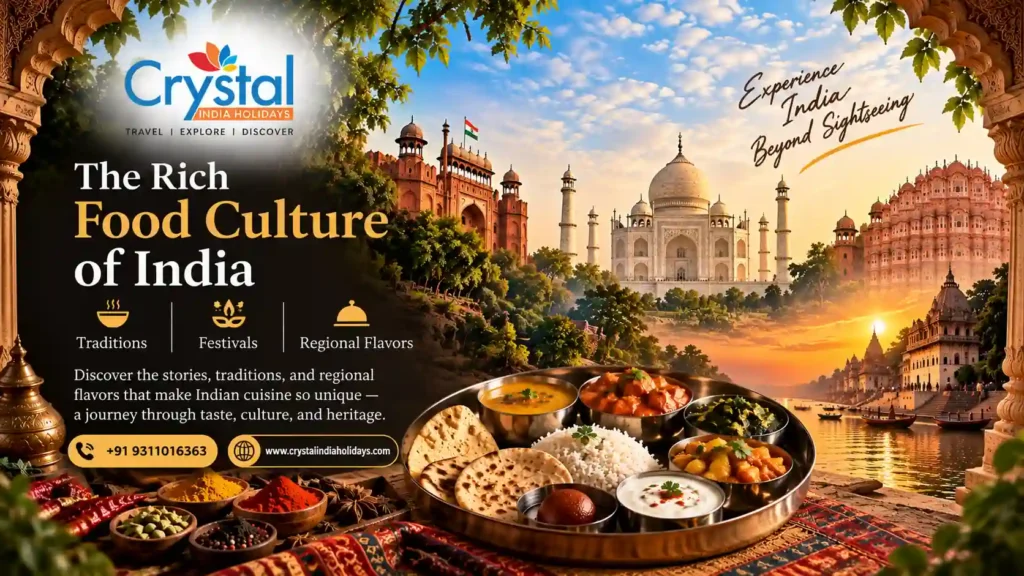
In most Indian homes, a meal is never just a meal. It’s the reason a family gathers on a Sunday afternoon, the centerpiece of a wedding that runs for days, and the first thing anyone plans around a festival. The culture of Indian food isn’t a single cuisine or a fixed set of rules – it’s a living, region-by-region, festival-by-festival way of eating that has been shaped by geography, religion, climate, and centuries of exchange between communities.
This guide, brought to you by Crystal India Holidays, walks through what makes that culture distinct: the everyday customs (how Indians eat, not just what), the regional differences that make a Kerala thali look nothing like a Punjabi one, the festival dishes that carry symbolic meaning, and the seasonal logic that ties food to the harvest calendar. Whether you’re planning a trip to India with us, cooking for the first time, or simply curious about why food matters so much here, this is the full picture.
Why the Culture of Indian Food Runs So Deep
Food in India carries weight that goes beyond taste. Three things explain why:
- Religion shapes what’s on the plate. Hindu, Muslim, Sikh, Jain, and Christian communities each have their own food rules, fasting practices, and festival dishes. Jain cooking skips root vegetables. Muslim families break the Ramzan fast with dates and sheer khurma. Sikh gurdwaras serve a free meal, called langar, to anyone who walks in.
- Geography decides the ingredients. Coastal states like Kerala and Goa use a lot of coconut, fish, and rice. Punjab and Haryana grow wheat, so their food centers on roti, dairy, and butter-rich gravies. Eastern states like West Bengal and Odisha grow rice, so meals build around rice with fish or lentils. It all comes down to what the land grows.
- Rituals turn eating into meaning. Offering food to a deity before the family eats it (called prasad), fasting before a festival, and feeding guests first as a sign of hospitality – these customs aren’t extras. They’re part of how many Indians think about a meal in the first place.
Together, these three forces explain why the culture of Indian food is so closely tied to India’s culture as a whole – you can’t really separate the two.
Everyday Food Traditions That Define Indian Culture
Before getting to festivals, it helps to know a few everyday customs. These are the foundation everything else builds on.
- Eating with hands. In much of India, people eat with the right hand instead of cutlery. In Ayurveda, the fingertips are linked to the five elements, and touching food before eating is believed to sharpen the senses. It’s practical too – rice, dal, and sabzi mix more evenly by hand than with a fork.
- The thali system. A thali is one platter with several small dishes at once – usually rice or roti, a dal, one or two vegetables, curd or raita, a pickle, and something sweet. The goal is to fit all six tastes recognized in Indian food philosophy – sweet, sour, salty, bitter, pungent, and astringent – into a single meal.
- Spices as the backbone, not the garnish. Turmeric, cumin, coriander, mustard seed, and cardamom aren’t sprinkled on at the end. They’re cooked into the dish from the start, often bloomed in hot oil first (a step called tempering, or tadka). Most kitchens keep a masala dabba, a round spice box with the five or six spices used every day.
- Vegetarianism is widespread, but not universal. India is widely recognized as home to one of the largest vegetarian populations in the world, largely because of Hindu, Jain, and Buddhist food traditions. But India isn’t uniformly vegetarian – meat, fish, and eggs are everyday food in large parts of the country, especially the northeast, coastal regions, and many Muslim, Christian, and Sikh households.
Regional Food Cultures Across India
There’s no single “Indian food” – there are dozens of regional food cultures, each shaped by its own climate, crops, and history.
| Region | Staple ingredients | Signature dishes | What shapes the cuisine |
| North India (Punjab, Delhi, UP) | Wheat, dairy, butter, ghee | Butter chicken, dal makhani, chole bhature, paranthas | Fertile wheat belt, dairy-rich Punjabi tradition, Mughal culinary influence |
| South India (Tamil Nadu, Kerala, Karnataka, Andhra) | Rice, coconut, lentils, curry leaves | Dosa, idli, sambar, appam, Chettinad curries | Rice cultivation, coastal access to coconut and seafood, fermentation techniques |
| West India (Gujarat, Maharashtra, Rajasthan) | Millets, lentils, dairy, dried spices | Dhokla, pav bhaji, laal maas, gatte ki sabzi | Arid Rajasthan favors preserved and dairy-heavy food; Gujarat leans sweet-savory; Maharashtra blends coastal and inland styles |
| East India (West Bengal, Odisha, Bihar) | Rice, mustard oil, fish, lentils | Fish curry, mishti doi, litti chowka | River and coastal fish access, mustard cultivation, strong sweet-making tradition |
| Northeast India (Assam, Nagaland, Manipur, and others) | Rice, bamboo shoot, fermented foods, pork | Bamboo shoot curry, axone-based dishes, smoked meats | Hill agriculture, fermentation as preservation, distinct tribal culinary identities separate from mainland India |
The point isn’t just variety for its own sake – it’s that each region’s food developed as a practical response to what was actually available to cook with. A Bengali fish curry and a Rajasthani laal maas exist for opposite reasons: one comes from abundant rivers, the other from a desert where meat had to be preserved with heavy spice and oil.
Festival-by-Festival: What India Eats and Why
No look at Indian food culture is complete without festivals. This is where food and meaning meet most clearly. Here’s what’s really going on behind the dishes:
- Diwali (across India, autumn): Sweets take center stage – laddoos, barfis, gujiyas – because Diwali marks light winning over darkness, and sweetness stands for good fortune. Families exchange boxes of mithai with neighbors. Maharashtrian homes prepare an elaborate spread called faral, while Bengali households mark the same period with Kali Puja and its own food traditions, including dishes made without onion or garlic.
- Holi (North and Central India, spring): Gujiya (a sweet dumpling filled with dried fruit and khoya) and thandai (a chilled, spiced milk drink) are the signature foods. Holi is a loud, communal festival, so both are shared freely as people move from house to house.
- Eid-ul-Fitr (Muslim communities nationwide, date shifts each year): The fast-breaking meal usually opens with dates, then moves to biryani and sheer khurma, a vermicelli pudding cooked in milk with dried fruit and nuts. Eid is about generosity, so it’s common to prepare enough to share with neighbors of any faith.
- Pongal / Makar Sankranti (Tamil Nadu and across India under different names, mid-January): A harvest festival, so the food centers on rice. Sakkarai pongal (sweet rice with jaggery, moong dal, and ghee) and ven pongal (a savory version with black pepper and cumin) are both named after the festival – the word means “to boil over,” a symbol of abundance.
- Onam (Kerala, August-September): Marked by the Onam sadya, a vegetarian feast of 20 or more dishes served on a banana leaf and eaten in a set order. It’s one of the clearest examples of the meal itself being the ritual, not just a side to one.
- Durga Puja / Kali Puja (West Bengal, autumn): Bhog, a shared vegetarian meal that usually includes khichuri (a rice-lentil dish) and mixed vegetables, is handed out daily at pandals through the festival. On the final days of related celebrations, dishes like mutton curry show up in many Bengali homes.
- Baisakhi / Lohri (Punjab, mid-January): Both mark the rabi (spring) harvest. Sarson da saag with makki di roti, plus sweets made from til (sesame) and gur (jaggery), reflect whatever’s freshly harvested that time of year.
One pattern shows up again and again: festival food in India is almost never random. It ties back to what a region grows, what a religious calendar asks for, or what a specific legend or ritual calls for.
Quick Reference: Festival, Region, and Dish
| Festival | Primary region | Signature dish | Symbolic meaning |
| Diwali | Nationwide | Laddoo, barfi, gujiya | Sweetness as a symbol of light overcoming darkness |
| Holi | North & Central India | Gujiya, thandai | Shared abundance during a communal spring festival |
| Eid-ul-Fitr | Nationwide Muslim communities | Biryani, sheer khurma | Breaking the fast with generosity and hospitality |
| Pongal / Makar Sankranti | Tamil Nadu, pan-India | Sakkarai pongal, ven pongal | Gratitude for the rice harvest |
| Onam | Kerala | Onam sadya (banana-leaf feast) | The meal itself as the central ritual |
| Durga Puja / Kali Puja | West Bengal | Khichuri bhog, mutton curry | Communal feeding and seasonal transition |
| Baisakhi / Lohri | Punjab | Sarson da saag, makki di roti, til-gur sweets | Celebrating the rabi harvest |
Harvest Festivals and Seasonal Eating
A large share of India’s festival calendar is agricultural at its core, which is easy to miss if you only look at the religious surface. Because India is still a largely agrarian country, many festivals mark specific points in the crop cycle rather than fixed religious dates:
- Makar Sankranti / Pongal (mid-January) marks the sun’s transition and the rice harvest across much of the country.
- Baisakhi (mid-April) celebrates the rabi (spring) harvest in Punjab – wheat, mustard, and other crops sown in winter.
- Navratri (autumn) roughly coincides with the harvest of rice, dals, and rajma in several regions, and many observant households shift toward simpler, grain-based fasting foods during this period.
The practical effect is that festival food is, more often than not, seasonal food. A festival dish made with freshly harvested jaggery, sesame, or rice isn’t a coincidence – it’s using what’s abundant at that exact moment in the agricultural year. This is also why the same broad festival (like Makar Sankranti) produces different dishes in different states: each region is celebrating its own local harvest, not a single national one.
Community, Sharing, and the Culture of Feasting
One of the most consistent threads across Indian food culture is that eating is rarely a solo activity when a festival or ritual is involved. A few examples make the pattern clear:
- Langar, the free community kitchen run at every Sikh gurdwara, serves a vegetarian meal to anyone who enters – regardless of religion, caste, or background. It’s one of the largest ongoing examples of communal free feeding anywhere in the world.
- Bhog at Durga Puja pandals in West Bengal is distributed to visitors daily throughout the festival, turning temporary religious spaces into informal community kitchens.
- Onam sadya in Kerala is traditionally eaten seated on the floor in a row, with the meal served to everyone together – the shared seating is as much a part of the tradition as the food itself.
It’s also worth being honest about the fact that “communal” doesn’t always mean “equal.” Who cooks, who is served first, and who eats last can still follow older social hierarchies in some households and communities, even during festivals built around the idea of togetherness. Acknowledging that nuance doesn’t take away from the genuine spirit of sharing that defines most Indian festival meals – it just makes the picture more complete.
How India’s Food Traditions Are Evolving Today
India’s food culture isn’t frozen in the past – it’s actively changing, in a few visible ways:
- Street food has become its own cultural identity. Dishes like pani puri, vada pav, and Delhi-style chaat started as local, informal snacks and have grown into symbols of their cities, now drawing food tourism in their own right.
- Urban households increasingly outsource festival cooking. Ordering mithai or a festive spread from a local sweet shop, rather than making everything from scratch, is common in cities today – and most families still consider this “celebrating properly,” since the shared eating matters more than who cooked.
- Organic and farm-to-table interest is reviving older methods. A renewed focus on regional, seasonal ingredients – partly driven by health-conscious urban consumers – is bringing traditional preparation techniques back into restaurants and home kitchens that had drifted toward convenience food.
- Documentation is becoming more deliberate. As younger generations move between cities or abroad, more families and food writers are actively recording recipes and festival food traditions – through blogs, social media, and video – that were previously passed down only by word of mouth.
The throughline is that India’s food culture keeps absorbing change without losing its regional and festival-rooted character – it adapts rather than disappears.
Frequently Asked Questions
What best describes the culture of Indian food? It’s a regionally diverse, festival-driven food culture shaped by religion, geography, and ritual – where eating customs (like sharing meals communally or eating with hands) matter as much as the dishes themselves.
Why is food so important during Indian festivals? Festival food carries symbolic meaning – sweetness for prosperity, specific dishes tied to religious offerings, or harvest-based ingredients marking the agricultural calendar – rather than being just an accompaniment to the celebration.
What is a thali? A thali is a single platter carrying multiple small dishes – typically a grain, a dal, one or two vegetables, a curd or pickle, and a sweet – designed to include all six recognized tastes in Indian food philosophy in one meal.
Is all Indian food vegetarian? No. India has a large vegetarian population, particularly among Hindu, Jain, and Buddhist communities, but meat, fish, and eggs are everyday staples across large parts of the country, including the northeast, coastal regions, and many Muslim, Christian, and Sikh households.
What is langar? Langar is a free community meal served daily at Sikh gurdwaras to anyone who enters, regardless of religion or background – one of the most visible expressions of communal eating in Indian food culture.
Why does Indian food vary so much by region? Regional cuisine follows what each area’s climate and land actually produce – rice and coconut along the coasts, wheat and dairy in the north, millets and dried spices in arid western states – so ingredients and cooking styles differ sharply from one region to the next.
How is festival food connected to the harvest calendar? Many major festivals – Pongal, Makar Sankranti, Baisakhi – fall at specific points in the crop cycle, and their signature dishes are typically made from whatever is freshly harvested at that time.
Experience the Culture of Indian Food Firsthand
Reading about India’s food traditions only goes so far – the real thing happens at a Diwali sweet counter in Delhi’s Chandni Chowk, an Onam sadya in Kerala, or a plate of sakkarai pongal in a Tamil Nadu temple town. If your visit to India happens to line up with one of these festivals, it’s worth building a little room in the itinerary to actually experience the food, not just see the sights around it.