
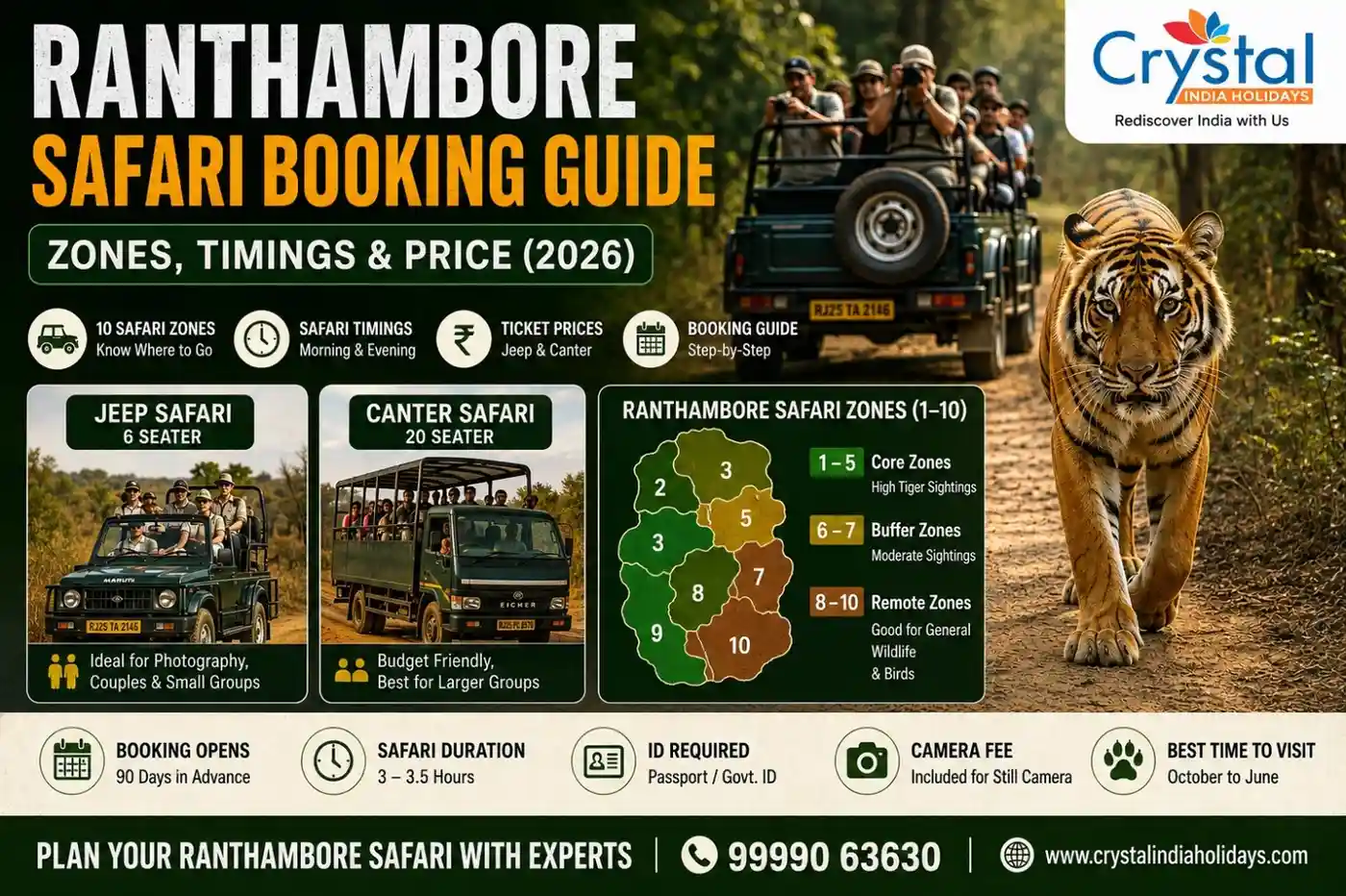
Booking a Ranthambore safari sounds simple until you actually try to do it – suddenly you’re staring at ten different zones, two vehicle types, a government portal that opens exactly 90 days in advance, and no clear answer on which combination actually gives you the best shot at seeing a tiger.
We get it. We’ve booked thousands of safaris for guests over the years, and the zone-and-timing puzzle is the single most common question we’re asked.
This guide walks you through everything: safari types, what each of the ten zones is actually like, current pricing, the exact booking process, and – most importantly – how to pick a zone that gives you a genuine chance of a sighting instead of just picking a number at random.
Quick Answer
Ranthambore National Park safaris run in two formats – 6-seater Jeep safaris and 20-seater Canter safaris – across ten numbered zones, with Zones 1 to 5 generally offering the strongest tiger sighting chances thanks to their water bodies and open terrain. Safari booking opens exactly 90 days before your travel date through the official Rajasthan forest department portal, and prices range from roughly ₹2,000 to ₹6,000 ($24–$72) per person depending on safari type and nationality.
Types of Safari in Ranthambore
Ranthambore offers two safari formats, and choosing between them affects both your budget and your experience.
Jeep Safari (6-Seater Gypsy)
A Jeep, or Gypsy, seats a maximum of six people plus a guide, giving you far more flexibility to move around, ask questions, and get a clearer view when a tiger does appear. It’s pricier than the Canter, but for genuine wildlife photography or a more personal experience, it’s worth the extra cost.
Canter Safari (20-Seater Open Bus)
The Canter is a larger, open-top vehicle that carries up to 20 people. It’s budget-friendly and a good option for group travelers or families on a tighter budget, though you’ll have less room to maneuver for photos and a shared experience rather than a private one.
| Safari Type | Seats | Price Range (per person) | Best For |
| Jeep (Gypsy) | 6 | ₹4,000–₹6,000 ($48–$72) | Photography, couples, small groups |
| Canter | 20 | ₹2,000–₹3,000 ($24–$36) | Budget travelers, larger groups |
Ranthambore Safari Zones Explained (Zone 1–10)
This is where most safari guides fall short – they’ll mention “zones exist” without explaining what actually separates them. Here’s the honest breakdown.
Core Zones (1–5)
These sit closest to the park’s main water bodies – Padam Talao, Rajbagh, and Malik Talao – and generally see the most consistent tiger movement, since tigers gravitate toward water, especially in the warmer months.
- Zone 1 & 2: Open terrain around the lakes, historically strong for sightings, particularly in summer when tigers come to cool off near water.
- Zone 3: Considered one of the most reliable zones overall, with a good mix of open grassland and forest.
- Zone 4: Similar terrain to Zone 3, often just as productive, though slightly less crowded.
- Zone 5: Dense forest cover; sightings can be excellent but slightly less predictable than 3 and 4.
Buffer Zones (6–10)
These sit further from the core water sources and see fewer crowds, which some experienced safari-goers actually prefer.
- Zone 6 & 7: Quieter, with decent sighting chances outside peak summer, and a good alternative if core zones are fully booked.
- Zone 8, 9 & 10: More remote, better suited to travelers interested in overall biodiversity – birds, deer, and landscape – rather than a tiger-focused trip.
| Zone | Tiger Sighting Chance | Terrain Type | Best Season |
| 1–2 | High (summer) | Open, lakeside | March–June |
| 3–4 | High (year-round) | Mixed grassland/forest | October–June |
| 5 | Moderate–High | Dense forest | October–March |
| 6–7 | Moderate | Buffer, mixed terrain | October–March |
| 8–10 | Lower for tigers, good for general wildlife | Remote, forested | October–March |
Keep in mind that zone allocation for online bookings is often randomized or assigned by the system rather than fully chosen by you, so while you can express a preference, guaranteed placement in a specific zone isn’t always possible through the general portal – this is one area where working with an experienced local operator genuinely helps.
Safari Timings – Morning vs. Evening
Safari timings shift with the seasons, since sunrise and sunset times change throughout the year.
| Season | Morning Safari | Evening Safari |
| October–February | 7:00 AM – 10:30 AM | 2:30 PM – 6:00 PM |
| March–April | 6:30 AM – 10:00 AM | 3:00 PM – 6:30 PM |
| May–June | 6:00 AM – 9:30 AM | 3:30 PM – 7:00 PM |
Morning safaris tend to be cooler and, in our experience, slightly better for spotting activity near water bodies before the day heats up. Evening safaris offer softer light for photography and a good chance of seeing animals heading toward water as temperatures drop.
Ranthambore Safari Ticket Price 2026
Prices vary by vehicle type, nationality, and whether you’re booking directly or through an operator.
| Safari Type | Indian Visitor | Foreign Visitor | Camera Fee |
| Jeep Safari | ₹1,500–₹2,000 | ₹4,500–₹6,000 ($54–$72) | Included for still cameras |
| Canter Safari | ₹800–₹1,200 | ₹2,000–₹3,000 ($24–$36) | Included for still cameras |
Additional charges may apply for professional video cameras or specialized photography equipment – check current rates before your trip, as these are periodically revised.
How to Book Ranthambore Safari Online
Booking directly through the official Rajasthan forest department portal is possible, but the process trips up a lot of first-time visitors. Here’s how it actually works:
- Check the booking window. Safari slots open exactly 90 days before your travel date – not sooner. Mark your calendar, since popular dates fill within hours.
- Register on the official portal with your passport (for foreign nationals) or ID details.
- Select your date, safari type, and preferred zone, keeping in mind that zone confirmation isn’t always guaranteed.
- Make payment online through the accepted payment methods.
- Download and print your confirmed permit – you’ll need this at the gate, along with photo ID.
A word of caution: the portal can be slow, especially right when the 90-day window opens for popular winter dates, and it occasionally experiences downtime. This is exactly the kind of process where a travel operator with local relationships can save you a frustrating morning of refreshing a webpage.
How to Choose the Best Zone for Tiger Sighting
When we’re arranging safaris for guests, we weigh a few factors before recommending a zone:
- Season: Summer favors zones near water (1, 2, 3); winter opens up more even chances across zones 3–7.
- Time of stay: If you’re only doing one safari, we lean toward Zones 3 or 4 for consistency. If you have two or three safaris booked, mixing core and buffer zones gives a fuller picture of the park.
- Group size and interest: Serious photographers often prefer quieter buffer zones with fewer vehicles crowding a sighting, even if the odds are marginally lower.
- Recent activity: Local guides often know which zones have had recent tiger movement – this kind of real-time knowledge simply isn’t available through the booking portal itself.
Common Mistakes to Avoid While Booking
- Waiting too long to book. Popular dates and zones for winter safaris (October–March) can sell out within days of the 90-day window opening.
- Assuming you can pick your exact zone freely. Online bookings often assign zones through a semi-randomized system.
- Forgetting required identification. Foreign nationals need a valid passport for both booking and gate entry – a photocopy isn’t accepted.
- Booking only one safari. A single safari doesn’t guarantee a tiger sighting; two or three across different zones significantly improves your odds.
- Ignoring the dress code and gate timing. Arriving late means missing your slot entirely, with no refund.
Book Your Ranthambore Safari with Crystal India Holidays
We handle the entire booking process for you – zone selection based on season and recent sightings, permits, and gate logistics – so you’re not gambling with a government portal 90 days out. We also combine safari bookings with your hotel and transport, so everything lines up without early-morning scrambling.
Frequently Asked Questions
How do I book a Ranthambore safari?
Book through the official Rajasthan forest department portal, which opens exactly 90 days before your travel date, or through a travel operator who handles the process for you.
Which is the best zone for tiger sightings in Ranthambore?
Zones 3 and 4 are generally the most consistent year-round, while Zones 1 and 2 perform especially well in summer near the lakes.
How much does a Ranthambore safari cost?
A Jeep safari costs roughly ₹4,500–₹6,000 ($54–$72) for foreign visitors, while a Canter safari costs about ₹2,000–₹3,000 ($24–$36).
How many days in advance should I book?
Book as soon as the 90-day window opens, especially for winter travel (October–March), since popular dates fill quickly.
Can I choose my exact safari zone?
You can express a preference, but online bookings often assign zones through a semi-randomized system rather than guaranteeing your first choice.
Is a Jeep safari better than a Canter safari?
Jeep safaris offer more flexibility and better photography angles, while Canters are more budget-friendly for larger groups.
Key Takeaways
- Ranthambore offers two safari types: 6-seater Jeeps and 20-seater Canters, with Jeeps offering better photography access.
- Zones 1–5 (core) generally offer the strongest tiger sighting chances; Zones 6–10 (buffer) are quieter alternatives.
- Booking opens exactly 90 days before your travel date and fills quickly for winter dates.
- Foreign visitors need a valid passport for both booking and gate entry.
- Booking multiple safaris across different zones improves your overall chances of a sighting.
Conclusion
A great Ranthambore safari comes down to picking the right combination of vehicle type, zone, and timing – and booking early enough to actually get a slot. Whether you’re chasing a photography-perfect Jeep safari through Zone 3 or a more relaxed Canter ride through the buffer zones, understanding these details before you book makes all the difference.
Want us to handle the zone selection, permits, and timing for you? Book your Ranthambore safari with Crystal India Holidays and skip the guesswork entirely.
Related Reading:
→ Best Resorts & Hotels Near Ranthambore National Park
→ How to Reach Ranthambore National Park

Comment (0)