

Delhi does not give up its charm in one visit. You could spend a week here and still find a lane you have not walked, a market you have not tasted, a monument you have not photographed. If you are staring at a map of the capital wondering where to start, you are not alone – this is the single question every visitor to Delhi asks first.
This guide is built to answer it properly. Instead of another list of “top places,” you get a working travel plan: what to see, when to go, how to reach each spot by metro, what it costs, and which places genuinely come alive after sunset. Whether you have one day, a weekend, or a full week, and whether you are travelling with family, with a partner, or completely solo, you will find a route that fits.
Key Takeaways
- Delhi blends Mughal history, colonial architecture, and modern India in one city, making it India’s most complete cultural destination.
- India Gate, Red Fort, Qutub Minar, and Humayun’s Tomb form the essential historical circuit, and all are metro-accessible.
- Lotus Temple, Akshardham, Bangla Sahib, and Jama Masjid cover Delhi’s major religious tourism spots, most with free entry.
- Delhi’s nightlife is not just clubs – night markets, food streets, and illuminated monuments make it one of the best cities in India to explore after dark.
- A well-planned one-day itinerary can realistically cover 5–6 major attractions using the Delhi Metro.
- October to March is the best season to visit; summers are extremely hot, and monsoon brings short, heavy showers.
- Budget travellers can see most of Delhi’s iconic sites for under ₹500 a day, since many landmarks are free or charge a nominal entry fee.
Why Delhi Is One of India’s Best Tourist Destinations
Delhi is one of the few cities in the world where a 12th-century minaret, a Mughal fort, a British-era boulevard, and an ultra-modern temple complex all sit within a 30-minute metro ride of each other. Few cities have this layered a story, and even fewer make it this easy to access on a modest budget.
As the national capital, Delhi is also India’s best-connected city – an international airport, a dense metro network, and highway links to Agra, Jaipur, and the hill stations of the north make it a natural base for a longer India trip. Add to this a food scene that ranges from 500-year-old kebab shops in Chandni Chowk to rooftop cafés in Hauz Khas Village, and you have a destination that rewards both a rushed weekend and a leisurely week.
Top Places to Visit in Delhi
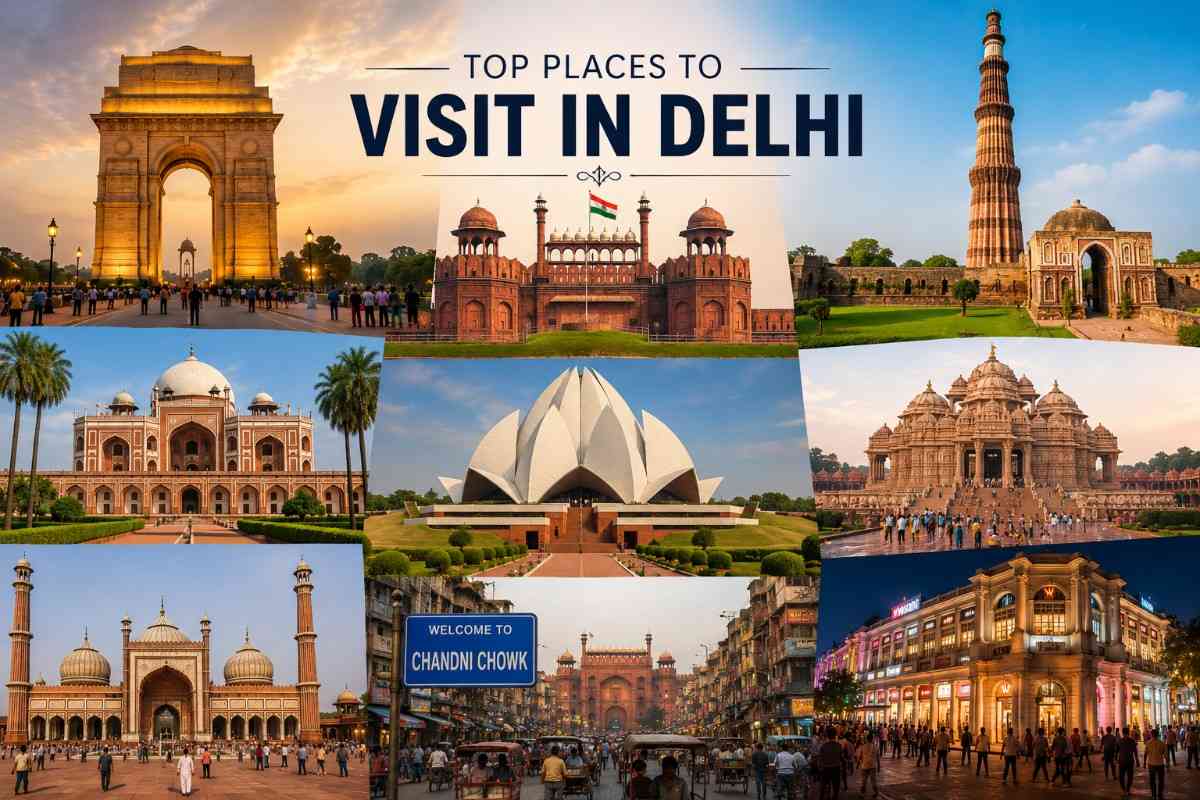
Here is a comparison of Delhi’s most-visited attractions to help you plan quickly.
| Attraction | Best For | Entry Fee (Indian / Foreign) | Timings | Nearest Metro |
|---|---|---|---|---|
| India Gate | Everyone, night walks | Free | All Day | Central Secretariat |
| Red Fort | History lovers | ₹35 / ₹550 | 9:30 AM – 4:30 PM (Closed Monday) | Chandni Chowk |
| Qutub Minar | Architecture, photography | ₹35 / ₹550 | 7:00 AM – 5:00 PM | Qutub Minar |
| Humayun’s Tomb | Mughal architecture | ₹35 / ₹550 | 6:00 AM – 6:00 PM | JLN Stadium |
| Lotus Temple | Peace, reflection | Free | Varies by season (Closed Monday) | Kalkaji Mandir |
| Akshardham | Families, evening shows | Free (Show tickets extra) | 9:30 AM – 8:00 PM (Closed Monday) | Akshardham |
| Jama Masjid | Religious heritage | Free (Camera fee extra) | 7:00 AM – 12:00 PM & 1:30 PM – 6:30 PM | Jama Masjid |
| Chandni Chowk | Food, shopping | Free | All Day (Evenings Best) | Chandni Chowk |
| Hauz Khas Village | Cafés, nightlife | Free | All Day (Evenings Best) | Hauz Khas |
| Connaught Place | Shopping, dining | Free | All Day (Evenings Best) | Rajiv Chowk |
Why Visit India Gate: It is Delhi’s most photographed landmark and the emotional heart of the city. Highlights: War memorial, Amar Jawan Jyoti, wide lawns, evening lights. Best Time: Evening, 6 PM onward. Local Tip: Carry a mat or light sheet – locals picnic on the lawns after sunset, and it is one of the safest, most family-friendly spots in Delhi at night.
Why Visit Red Fort: This UNESCO World Heritage Site was the seat of Mughal power for two centuries and is where India’s Prime Minister hoists the national flag every Independence Day. Highlights: Diwan-i-Aam, Diwan-i-Khas, Moti Masjid, evening light and sound show. Visit Duration: 2–3 hours. Nearby Attractions: Jama Masjid, Chandni Chowk, Raj Ghat. Local Tip: Book tickets online to skip the queue, and stay back for the light and sound show if you enjoy history told through narration.
Why Visit Qutub Minar: It is the tallest brick minaret in the world and a masterclass in Indo-Islamic architecture. Highlights: The 73-metre minaret, the Iron Pillar, Quwwat-ul-Islam Mosque. Visit Duration: 1.5–2 hours. Local Tip: Visit early morning for softer light and far fewer crowds – this makes a real difference for photography.
Why Visit Humayun’s Tomb: Built for Emperor Humayun, this garden tomb inspired the design of the Taj Mahal and remains one of the most peaceful heritage sites in the city. Highlights: Charbagh gardens, red sandstone façade, adjoining Sunder Nursery. Visit Duration: 1.5 hours. Local Tip: Combine this with Sunder Nursery next door for a quiet, green extension to your visit.
Historical Places in Delhi
Delhi’s historical core spans nearly 800 years of rule – from the Delhi Sultanate to the British Raj. Beyond Red Fort and Qutub Minar, seek out Purana Qila, believed to stand on the site of the legendary city of Indraprastha, and Agrasen Ki Baoli, a striking stepwell tucked away near Connaught Place that most tourists never find. Raj Ghat, the memorial where Mahatma Gandhi was cremated, and Jantar Mantar, an 18th-century astronomical observatory, round out a serious history circuit.
| Site | Era | Entry Fee (Indian / Foreign) | Ideal For |
|---|---|---|---|
| Red Fort | Mughal | ₹35 / ₹500–550 | First-time visitors |
| Qutub Minar | Delhi Sultanate | ₹35 / ₹550 | Architecture lovers |
| Purana Qila | Mughal / Legendary | ₹25 / ₹300 | History enthusiasts |
| Agrasen Ki Baoli | Medieval | Free | Hidden-gem seekers |
| Jantar Mantar | 18th Century | ₹15 / ₹200 | Curious travellers |
| Raj Ghat | Modern India | Free | Reflective visits |
Local Tip: Most historical sites are far less crowded on weekday mornings, and the Archaeological Survey of India revises fees periodically, so it is worth checking the official ASI site before your trip.
Religious Places in Delhi
Delhi’s religious sites reflect the city’s role as home to nearly every major faith in India. Lotus Temple, the Bahá’í House of Worship shaped like a blooming lotus, welcomes visitors of all faiths for quiet reflection. Akshardham Temple, dedicated to Bhagwan Swaminarayan, combines intricate stone carving with a musical fountain show in the evening. Jama Masjid, one of India’s largest mosques, and Gurudwara Bangla Sahib, known for its free community kitchen (langar) that feeds thousands daily, are equally essential stops.
What are the best free attractions in Delhi? India Gate, Lotus Temple, Jama Masjid, Bangla Sahib Gurudwara, Raj Ghat, and Agrasen Ki Baoli all offer free entry, making them ideal for budget travellers.
Local Tip: At Bangla Sahib and Jama Masjid, dress modestly – cover your shoulders and knees, and be ready to remove your shoes at the entrance.
Delhi Places to visit with Family
Which places are best for families? Akshardham Temple, National Museum, Lodhi Garden, Garden of Five Senses, and Dilli Haat top the list because they combine open space, safety, and things that keep children genuinely engaged.
| Attraction | Why Families Love It |
|---|---|
| Akshardham Temple | Exhibitions, boat ride, and evening musical fountain show |
| National Museum | Interactive history exhibits that are engaging for older kids |
| Lodhi Garden | Open lawns, jogging paths, and historic tombs to explore |
| Garden of Five Senses | Themed gardens, sculptures, and easy walking trails |
| Dilli Haat | Handicrafts, regional food stalls, and affordable shopping |
Local Tip: Visit Akshardham in the late afternoon so you can catch both the daylight architecture and the evening water show without doing two separate trips.
Romantic places visit in Delhi for Couples
Which places are romantic? Lodhi Garden at sunset, Hauz Khas Village for its lake-facing cafés, Humayun’s Tomb for quiet garden walks, and India Gate lawns after dark are consistently rated the most romantic spots in the city.
| Attraction | Romantic Appeal |
|---|---|
| Lodhi Garden | Sunset walks among centuries-old tombs |
| Hauz Khas Village | Candlelit rooftop dining with beautiful lake views |
| Humayun’s Tomb | Peaceful gardens surrounding a magnificent Mughal mausoleum |
| India Gate (Night) | Illuminated lawns, ice cream stalls, and a relaxed evening atmosphere |
Local Tip: Hauz Khas Village gets busy on weekend nights, so a weekday evening gives you a calmer, more intimate experience.
Best Places to Visit in Delhi at Night
What are the best places to visit in Delhi at night? India Gate, Connaught Place, Hauz Khas Village, Chandni Chowk’s food lanes, Dilli Haat, and the Akshardham musical fountain show are the delhi night places to visit, each offering a different flavour of Delhi nightlife – from illuminated monuments to buzzing markets.
| Night Spot | Why Go After Dark |
|---|---|
| India Gate | Illuminated war memorial, cool evening breeze, and a family-friendly atmosphere |
| Connaught Place | Rooftop bars, popular restaurants, and beautifully lit Georgian architecture |
| Hauz Khas Village | Live music venues, stylish lounges, and scenic lake views |
| Chandni Chowk | Famous late-night food streets serving parathas, kebabs, and jalebis |
| Dilli Haat | Open-air handicraft shopping and regional food stalls until 10 PM |
| Akshardham | Spectacular evening musical fountain show (check show timings before your visit) |
| Khan Market | Upscale cafés, bookstores, and a peaceful evening ambiance |
Delhi’s night food streets deserve special mention. Chandni Chowk’s Paranthe Wali Gali serves stuffed parathas that have barely changed in a century, while nearby stalls dish out butter chicken, kebabs, and syrupy jalebis well into the night. For a more organised night market experience, Dilli Haat in INA offers regional handicrafts and food from every Indian state in one open-air complex, open until around 10 PM.
Can Delhi be explored safely at night? Yes – India Gate, Connaught Place, and Hauz Khas Village are well-lit, heavily visited, and patrolled, making them safe for solo travellers and families alike. As with any big city, stick to well-populated areas and use registered taxis or the metro (which runs until around 11 PM) rather than walking long distances alone late at night.
Local Tip: If you only have one night in Delhi, pair India Gate (7 PM) with Connaught Place (8:30 PM) – they are a short metro ride apart and together capture both the monumental and modern sides of the city after dark.
One-Day Delhi Itinerary
If you only have 24 hours, this route uses the metro efficiently and mixes history, food, and nightlife.
Morning (8:30 AM–12 PM): Start at Humayun’s Tomb, then head to Qutub Minar. Both open early and are best visited before the midday heat and crowds build up.
Afternoon (12:30 PM–3:30 PM): Explore Red Fort and walk across to Jama Masjid. Grab lunch in Chandni Chowk – this is where Delhi’s food reputation truly comes from.
Evening (4 PM–6:30 PM): Take the metro to India Gate for a walk along Kartavya Path, then continue to Connaught Place for shopping or coffee.
Night (7 PM onward): Finish at Hauz Khas Village or return to Chandni Chowk for dinner among the night food stalls.
This plan covers roughly 6 major attractions, uses the metro for most transfers, and costs under ₹1,500 per person including entry fees, food, and local transport – a genuinely achievable Delhi one-day trip.
If you have a full weekend, split the plan: Day 1 for Old Delhi (Red Fort, Jama Masjid, Chandni Chowk, Raj Ghat), and Day 2 for New Delhi and South Delhi (Humayun’s Tomb, Qutub Minar, Lotus Temple, Hauz Khas, and an evening at Akshardham or Connaught Place). This Delhi weekend trip structure avoids backtracking across the city and gives each area the time it deserves.
Travel Tips
- Best time to visit: October to March, when daytime temperatures stay comfortable for sightseeing. Summers (April–June) cross 40°C, and the monsoon (July–September) brings sudden, heavy showers.
- Metro guide: The Delhi Metro connects almost every major attraction directly and is by far the fastest, cheapest way to move around. Buy a tourist smart card if you are staying more than two days to avoid queuing for tickets each time.
- Budget planning: Most historical monuments charge Indian citizens between ₹15 and ₹40; several major sites, including India Gate, Lotus Temple, and Jama Masjid, are free. A comfortable day of sightseeing, food, and metro travel can be managed for ₹1,000–₹1,500 per person.
- Safety tips: Keep valuables secure in crowded markets like Chandni Chowk and Sarojini Nagar, use registered taxis or app-based cabs after dark, and always negotiate autorickshaw fares before starting the ride, or insist on the meter.
- Photography tips: Early morning (7–9 AM) and golden hour (5–6:30 PM) give the softest light at outdoor monuments. Tripods usually need special permission at ASI-protected sites, so check in advance for serious shoots.
- Crowd insights: Weekday mornings are consistently quieter than weekends at every major monument. Independence Day and Republic Day bring heavy security and crowds near India Gate and Red Fort.
- Dress code: At religious sites such as Jama Masjid and Bangla Sahib, cover your shoulders and knees, and be prepared to remove footwear.
Frequently Asked Questions
1. What are the best places to visit in Delhi?
India Gate, Red Fort, Qutub Minar, Humayun’s Tomb, Lotus Temple, Akshardham, Jama Masjid, and Chandni Chowk are consistently ranked as Delhi’s must-visit attractions.
2. Which places in Delhi are best at night?
India Gate, Connaught Place, Hauz Khas Village, Chandni Chowk’s food lanes, and Dilli Haat are the best places to visit in Delhi at night.
3. Which attractions in Delhi are free to visit?
India Gate, Lotus Temple, Jama Masjid, Bangla Sahib Gurudwara, Raj Ghat, and Agrasen Ki Baoli offer free entry.
4. Which places are best for families?
Akshardham Temple, National Museum, Lodhi Garden, Garden of Five Senses, and Dilli Haat suit families with children of all ages.
5. Which places are most romantic for couples?
Lodhi Garden at sunset, Hauz Khas Village, Humayun’s Tomb, and India Gate at night are the most popular spots for couples.
6. Can Delhi be explored in one day?
Yes, a well-planned one-day itinerary using the Delhi Metro can cover 5–6 major attractions, including at least one historical site, a market, and a night stop.
7. What is the best season to visit Delhi?
October to March, when the weather is cool and comfortable for outdoor sightseeing.
8. How do I get around Delhi as a tourist?
The Delhi Metro is the fastest and most affordable way to reach almost every major attraction, supplemented by autorickshaws or app-based cabs for the last mile.
9. Is Delhi safe for solo travellers?
Yes, particularly in well-populated tourist areas. Stick to registered transport, avoid isolated areas at night, and keep copies of important documents.
10. What are some hidden gems in Delhi?
Agrasen Ki Baoli, Sunder Nursery, Garden of Five Senses, and Safdarjung’s Tomb are far less crowded than the headline attractions but equally rewarding.
11. Which are the best shopping markets in Delhi?
Chandni Chowk for traditional goods, Khan Market and Janpath for fashion, Sarojini Nagar for budget shopping, and Dilli Haat for handicrafts.
12. What is the entry fee for Red Fort?
Around ₹35 for Indian citizens and ₹500–550 for foreign nationals, though fees are periodically revised by the Archaeological Survey of India.
13. Is Qutub Minar open every day?
Yes, Qutub Minar is open daily, typically from 7 AM to 5 PM.
14. What food should I try in Delhi at night?
Stuffed parathas at Paranthe Wali Gali, butter chicken and kebabs in Chandni Chowk, and chaat and street snacks at Dilli Haat or Connaught Place.
15. How many days do I need to see Delhi properly?
Two to three days is enough to cover the major historical, religious, and market attractions without rushing; a week allows time for hidden gems as well.
Conclusion
Delhi rewards travellers who plan a little and wander a little. Stick to the metro, start early at the big monuments, and save your evenings for the markets and lit-up landmarks that make this city’s nightlife genuinely special. Whether it is your first trip to India or your fifth visit to the capital, this guide gives you enough structure to see Delhi properly, without missing the moments that only happen after the sun goes down.
If you would rather have this itinerary planned, guided, and booked for you – including hotels, local transport, and skip-the-line monument tickets – Crystal India Holidays can put together a custom Delhi trip that matches exactly how much time and budget you have.

Comment (0)