

25 Best Things to Do in Jaipur for Every Traveler
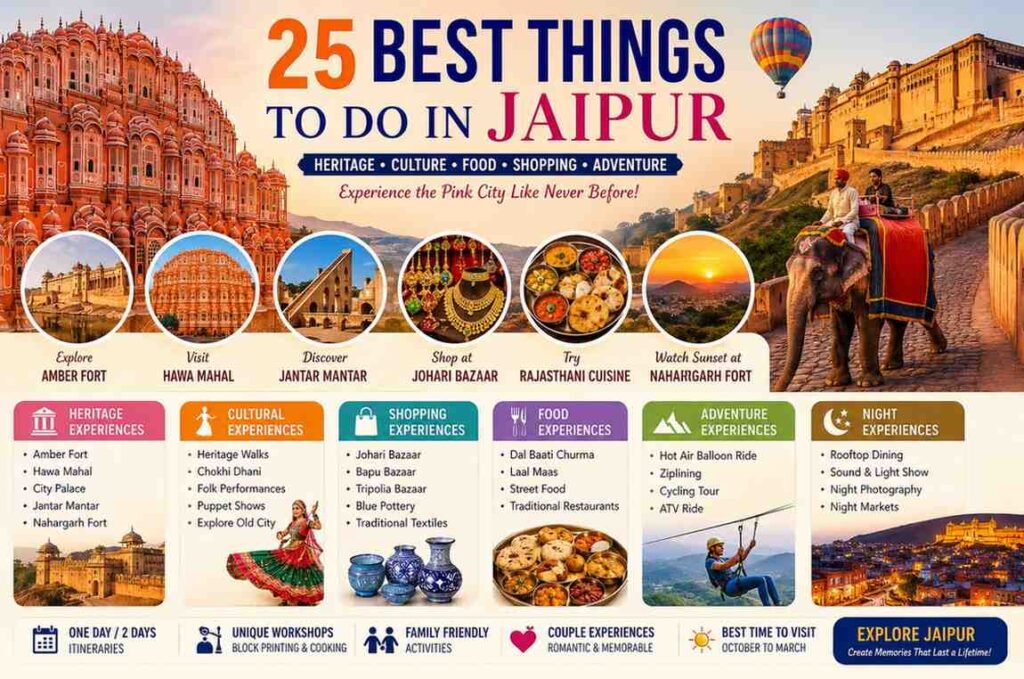
Jaipur, the capital of Rajasthan and famously known as the Pink City, offers a mix of heritage, culture, food, shopping, nightlife, and adventure experiences. The best things to do in Jaipur include exploring Amber Fort, taking a heritage walk through the old city, shopping in Johari Bazaar, trying authentic Rajasthani cuisine, enjoying a hot air balloon ride, and watching the sunset from Nahargarh Fort.
Whether you are visiting for one day or planning a longer Rajasthan itinerary, Jaipur combines royal history with vibrant local experiences. From UNESCO World Heritage Sites and traditional markets to cultural performances, food tours, and adventure activities, the city offers something for families, couples, solo travelers, and first-time visitors.
In this guide, you’ll discover the top things to do in Jaipur, including unique experiences, fun activities, evening attractions, shopping hotspots, local food experiences, and practical itineraries for making the most of your trip.
25 Best Things to Do in Jaipur
Heritage Experiences
1. Explore Amber Fort Perched on a rocky Aravalli ridge, Amber Fort is Jaipur’s most iconic landmark. Walk through the Ganesh Pol gate, marvel at the Sheesh Mahal’s mirror mosaics, and soak in panoramic views of Maota Lake below. Morning visits are coolest and least crowded.
2. Visit Hawa Mahal The Palace of Winds needs just 30–45 minutes but leaves a lasting impression. Its 953 latticed windows were designed so royal women could watch street processions unseen. The rear entrance gives you access to the upper floors — don’t skip it.
3. Tour City Palace Still partially home to the Jaipur royal family, City Palace blends Mughal and Rajput architecture across multiple courtyards. The Mubarak Mahal and Diwan-i-Khas house some of the finest textile and arms collections in Rajasthan.
4. Discover Jantar Mantar This 18th-century astronomical observatory is a UNESCO World Heritage Site and one of the most underrated things to do in Jaipur. The Samrat Yantra sundial — the world’s largest — can tell time to within two seconds. Hire a guide; the science here rewards explanation.
5. Watch Sunset at Nahargarh Fort Skip the long queue at the main entrance and head straight to the fort’s western bastions before 5 PM. The view over the Pink City as the sun drops behind the hills is one of the finest in all of Rajasthan.
Cultural Experiences
6. Join a Heritage Walk Several operators run guided morning walks through the walled city starting around 7 AM. You’ll visit havelis, neighborhood temples, spice markets, and textile workshops that most tourists never find. It’s consistently one of the most rewarding experiences in Jaipur.
7. Visit Chokhi Dhani This recreated Rajasthani village on the city’s southern edge brings folk culture to life with puppet shows, camel rides, fortune tellers, and a sprawling traditional thali dinner. It’s unabashedly touristy — and completely worth it for families and first-timers.
8. Attend Folk Performances The Ravindra Manch auditorium and various heritage hotels host Kathak dance and folk music evenings. The Rajasthani ghoomar dance, performed in swirling embroidered skirts, is mesmerizing.
9. Experience Puppet Shows Kathputli (string puppet) performances are a Rajasthani art form with roots going back centuries. Street performances happen organically near Hawa Mahal, while Chokhi Dhani offers more structured shows.
10. Explore Jaipur’s Old City The walled city — also called the Pink City — rewards slow, unplanned wandering. Duck into the lanes around Tripolia Gate, watch local life unfold at the Badi Chaupar intersection, and let yourself get pleasantly lost.
Shopping Experiences
11. Shop at Johari Bazaar Jaipur is India’s gemstone capital, and Johari Bazaar is where the trade happens. Emeralds, rubies, and kundan jewelry fill every shop. Even if you’re not buying, watching artisans set stones by hand is fascinating.
12. Explore Bapu Bazaar The go-to street for printed cotton fabrics, mojari shoes, lac bangles, and Rajasthani handicrafts. Prices are reasonable, bargaining is expected, and the chaos is part of the charm.
13. Visit Tripolia Bazaar Running parallel to the main road inside the walled city, Tripolia specializes in metalwork, brassware, and marble items. It’s less overwhelming than Johari Bazaar and easier to browse at your own pace.
14. Buy Blue Pottery Jaipur’s blue pottery — a Persian-influenced craft using quartz rather than clay — makes for distinctive, lightweight souvenirs. The best pieces come from workshops near Amer Road and Kripal Kumbh’s showroom in Bani Park.
15. Purchase Traditional Textiles Hand-block printed fabrics from Sanganer and Bagru villages are sold throughout the city. Look for running fabric by the meter rather than pre-stitched garments for better quality and value.
Food Experiences
16. Try Dal Baati Churma Rajasthan’s signature dish — hard wheat dumplings (baati) baked over a flame, served with lentil dal and crumbled sweet churma — is comfort food at its best. Laxmi Misthan Bhandar (LMB) in Johari Bazaar does a definitive version.
17. Taste Laal Maas This slow-cooked mutton curry with dried Mathania chilies is the kind of dish you think about for days afterward. It’s fiery, fragrant, and deeply satisfying. Spice Court and Suvarna Mahal at Rambagh Palace both do excellent renditions.
18. Enjoy Jaipur Street Food The street food scene alone justifies the trip. Start with pyaaz kachori (onion-filled fried pastry) at Rawat Mishthan Bhandar, move on to gol gappe at Pandit Ji near New Gate, and finish with ghevar (a disc-shaped sweet) during festival season.
19. Visit Traditional Restaurants Beyond street stalls, Jaipur has restaurants that genuinely celebrate Rajasthani cuisine. 1135 AD inside Amber Fort and Niros on MI Road are institutions worth booking in advance.
Adventure Experiences
20. Hot Air Balloon Ride Floating over Amber Fort and the Aravalli hills at sunrise is one of the most spectacular adventure things to do in Jaipur. Sky Waltz and Jaipur Balloons run daily flights between October and March, weather permitting. Book at least a week ahead.
21. Ziplining Flying Fox operates a multi-cable zipline circuit over Amber Fort’s ramparts and reservoir. It’s safe, well-managed, and gives you aerial views of the fort that no photograph can do justice.
22. Cycling Tour Early morning cycling tours through the old city and surrounding villages let you cover ground quietly and stop wherever curiosity strikes. Several operators offer e-bike options for those who’d rather not work up a sweat.
23. ATV Ride Off-road ATV rides through the rocky terrain surrounding Jaipur run from several camps near Kukas and Amber. Sessions typically last 30–60 minutes and require no prior experience.
Night Experiences
24. Rooftop Dining Jaipur’s rooftop restaurant scene is excellent. Café Palladio, Peacock Rooftop Restaurant near Hawa Mahal, and Tapri Central offer atmospheric evening dining with fort views and cool breezes after dark.
25. Jaipur Night Photography The illuminated monuments — especially Hawa Mahal and Amber Fort — look entirely different after dark. Join a photography walk or hire an auto-rickshaw for a self-guided light tour between 7 PM and 10 PM.
Fun, Unique & Adventure Things to Do in Jaipur
Beyond the standard itinerary, some of the most fun things to do in Jaipur involve getting your hands dirty — literally.
Block printing workshops in Sanganer village, 15 km south of Jaipur, let you design and print your own fabric using centuries-old carved wooden blocks. Most workshops last two to three hours and you leave with a piece you made yourself. It’s one of the truly unique things to do in Jaipur that connects you directly to the craft tradition.
Cooking classes are another worthwhile investment. A half-day session in a local home or heritage haveli teaches you to make dal baati churma, ker sangri, and Rajasthani chai from scratch. You eat what you cook, which makes it one of the most exciting things to do in Jaipur for food lovers.
For those chasing an adrenaline hit, the adventure things to do in Jaipur go well beyond Amber’s zipline. ATV riding through scrubland near Kukas, rock climbing on the Aravalli ridges, and overnight camping under the desert sky are all accessible from the city. Hot air ballooning remains the crown jewel of adventure things to do in Jaipur — nothing beats watching the Pink City materialize below you as the balloon lifts silently at dawn.
For something quieter, Jal Mahal (the Water Palace) is best experienced by walking the lakeside promenade at Mansagar Lake during golden hour, when photographers and families gather and the palace glows against the water.
Things to Do in Jaipur at Night & Evening
Jaipur’s evenings have a character all their own, and there’s no shortage of things to do in Jaipur at night.
Nahargarh Fort at sunset is the essential starting point. Reach the fort by 5 PM, stake out a spot on the bastions, and watch the light change over the city. The fort stays open until 8 PM and has a café with cold drinks and snacks.
Rooftop cafés are everywhere in the old city, and most offer unobstructed views of Hawa Mahal and the city walls. The atmosphere picks up after 7 PM when the monuments light up and the heat finally breaks.
For things to do in Jaipur in the evening with a cultural edge, the Rajasthani cultural show at Chokhi Dhani and the light-and-sound show at Amber Fort (held nightly) are both well-produced and genuinely entertaining. The Amber sound-and-light show runs in Hindi and English on alternate nights – check the schedule before you go.
Night markets around M.I. Road and Bapu Bazaar stay active until 10 PM, making late-evening browsing one of the more relaxed things to do in Jaipur in night hours when the daytime crowds have thinned.
For a final nightcap, rooftop bars at properties like Bar Palladio and Narain Niwas Palace offer cocktails infused with local spices – a fitting end to any day in the Pink City.
Things to Do in Jaipur in One Day or 2 Days
Things to Do in Jaipur in One Day
A tight but satisfying single-day itinerary is very doable if you start early.
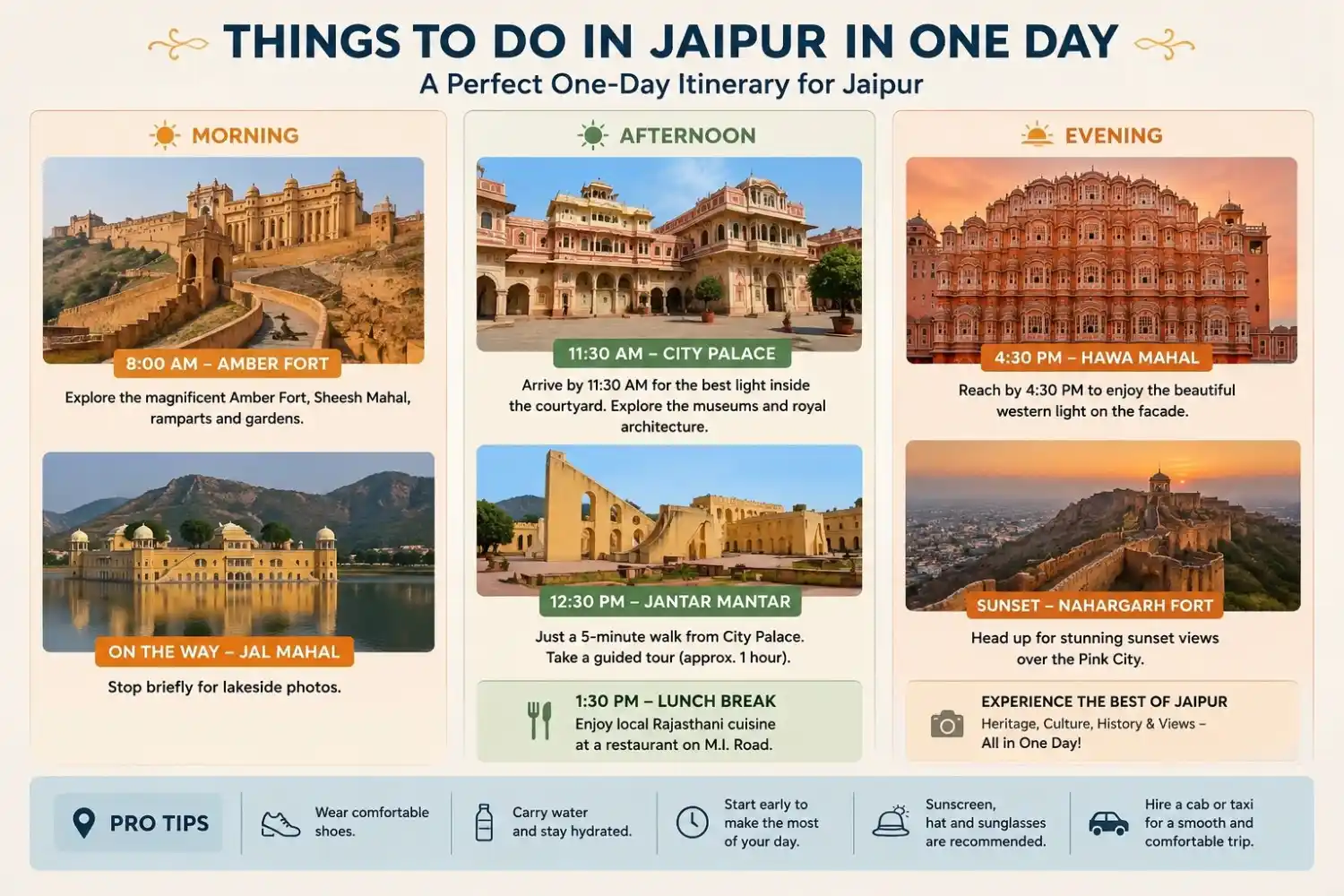
Morning: Head to Amber Fort by 8 AM before the crowds and heat arrive. Spend 90 minutes exploring the ramparts, Sheesh Mahal, and the gardens below. On the drive back, stop briefly at Jal Mahal for lakeside photos.
Afternoon: City Palace opens at 9:30 AM — aim to arrive by 11:30 AM, when the light inside the courtyard is good for photography. Jantar Mantar is a five-minute walk away and takes about an hour with a guide. Grab lunch at a restaurant on M.I. Road.
Evening: Reach Hawa Mahal by 4:30 PM to catch the western light on the facade. Then head up to Nahargarh Fort for sunset views over the city. This packs in the essentials of things to do in Jaipur in one day without feeling rushed.
Things to Do in Jaipur in 2 Days
Two days let you breathe, and the experience is significantly richer.
Day 1 — Heritage: Follow the one-day itinerary above, but at a slower pace. Add a guided heritage walk in the old city in the morning and the Amber Fort sound-and-light show in the evening.
Day 2 — Culture, Shopping & Food: Start with a cooking class or block printing workshop in the morning. Spend the afternoon exploring Johari Bazaar, Bapu Bazaar, and Tripolia Bazaar. Visit Chokhi Dhani in the evening for folk performances and a traditional thali dinner.
Things to do in Jaipur in 2 days naturally split between heritage on Day 1 and immersive local culture on Day 2 — a structure that most travelers find deeply satisfying.
Ready to experience Jaipur beyond the guidebooks? Explore the Pink City’s royal forts, vibrant markets, and cultural treasures with our Same Day Jaipur Tour From Delhi, Jaipur City Tour Package, or Jaipur Family Tour Package. Let Crystal India Holidays create a seamless and memorable Jaipur experience for you.
Things to Do in Jaipur Today & During Summer
If you’re planning things to do in Jaipur today, the time of year matters. Jaipur summers (April–June) are genuinely hot, with temperatures regularly crossing 40°C (104°F). The smart approach involves front-loading your day.
Early morning (6–9 AM): Cycle through the old city, visit Amber Fort, or take a sunrise balloon flight before the temperature rises.
Late morning to afternoon: Retreat indoors. The Albert Hall Museum (Rajasthan’s oldest museum) is air-conditioned and houses an exceptional collection of textiles, weapons, and natural history exhibits. City Palace and Jantar Mantar are also reasonably comfortable in the late morning.
Evening (5 PM onwards): Markets come alive, rooftop restaurants fill up, and the monuments light up after dark. This is when things to do in Jaipur in summers make the most sense — evenings here are genuinely pleasant.
For summer-specific tips: carry a reusable water bottle, wear light cotton, and book accommodation with a pool. Jaipur’s heritage hotels — Rambagh Palace, Samode Haveli, Narain Niwas — often offer off-season rates in summer that make them surprisingly affordable.
Why Jaipur Should Be on Every Traveler’s Bucket List
Among the many things to do in Jaipur city, what stays with travelers longest isn’t any single monument — it’s the texture of the place. A city that has lived continuously for nearly 300 years, where jewelers still work from the same lanes their great-grandfathers did, where every haveli hides a courtyard, and where a world-class meal can cost less than a cup of coffee in London.
The top things to do in Jaipur India blend effortlessly across experience types. Heritage and history for those drawn to the past. Shopping and craft for design lovers. Street food and fine dining for the gastronomically curious. Hot air balloons and ziplines for thrill-seekers. And folk performances, puppet shows, and cooking classes for anyone who wants to understand the culture rather than simply observe it.
Jaipur is also the gateway city for broader Rajasthan exploration — Jodhpur, Udaipur, and Pushkar are all reachable on day trips or short overnight journeys. As part of the Golden Triangle (Delhi–Agra–Jaipur), it fits naturally into most India itineraries.
No matter how you come at it, Jaipur rewards the effort.
Explore Jaipur with Crystal India Holidays
Planning a Jaipur trip is easy when you have the right team behind you. Crystal India Holidays specializes in curated travel experiences across Rajasthan, and their Jaipur expertise is hard to match.
Whether you’re looking for a same-day Jaipur sightseeing tour from Delhi, a comprehensive Golden Triangle Tour covering Delhi, Agra, and Jaipur, or a multi-week Rajasthan Tour Package that weaves through Jaipur, Jodhpur, Jaisalmer, and Udaipur, Crystal India Holidays builds itineraries around what you actually want to do rather than the standard checklist.
Their local tour guides bring Jaipur’s history to life – you’ll hear stories about the fort builders, the gem traders, and the royal families that no guidebook captures. Crystal India Holidays also offers customized travel experiences for families, solo travelers, honeymoon couples, and photography enthusiasts.
If you want to go beyond the obvious and discover Jaipur at its best, reach out to Crystal India Holidays to start planning. Their team is available to design your perfect itinerary today.
Frequently Asked Questions
1. What are the best things to do in Jaipur?
Explore Amber Fort, enjoy a heritage walk, shop at Johari Bazaar, try Rajasthani cuisine, watch sunset at Nahargarh Fort, and experience a hot air balloon ride.
2. What is Jaipur famous for?
Jaipur is famous for its royal forts, palaces, gemstone jewelry, colorful markets, Rajasthani food, and Pink City architecture that reflects rich Rajput heritage.
3. Why is Jaipur called the Pink City of India?
Jaipur was painted terracotta pink in 1876 to welcome the Prince of Wales. The color symbolized hospitality and became the city’s iconic identity.
4. Is Jaipur safe for tourists?
Jaipur is generally safe for tourists, including families and solo travelers. Basic precautions, trusted transport, and awareness in crowded markets are recommended.
Where is Jaipur located in India?
Jaipur is located in Rajasthan in northwestern India, around 280 km from Delhi. It serves as the state capital and a major tourism hub.
How many days are enough for Jaipur?
Two to three days are ideal for exploring Jaipur’s forts, markets, food scene, cultural attractions, and local experiences without feeling rushed.
What is the best month to visit Jaipur?
October to March is the best time to visit Jaipur. Pleasant weather makes sightseeing, shopping, outdoor activities, and cultural experiences more enjoyable.
What are the best things to do in Jaipur at night?
Enjoy rooftop dining, visit Nahargarh Fort for city views, watch the Amber Fort light show, explore night markets, and attend cultural performances.
What are some unique things to do in Jaipur?
Try block printing workshops, cooking classes, heritage walks, gemstone crafting demonstrations, village tours, and hot air balloon rides over Jaipur.
What are the best adventure things to do in Jaipur?
Popular adventure activities include hot air ballooning, ziplining, ATV rides, cycling tours, trekking in the Aravalli Hills, and outdoor camping.
What are the best things to do in Jaipur for couples?
Couples can enjoy romantic rooftop dinners, sunset views from Nahargarh Fort, luxury heritage stays, hot air balloon rides, and cultural evenings.
What are the best things to do in Jaipur with family?
Families can explore Amber Fort, Chokhi Dhani, Albert Hall Museum, cultural shows, local markets, and interactive heritage experiences together.
What are the best things to do in Jaipur with kids?
Kids enjoy puppet shows, elephant experiences, Chokhi Dhani activities, museums, toy train rides, and colorful market visits across Jaipur.
What are free things to do in Jaipur?
Free activities include exploring local markets, walking through the Pink City, visiting temples, enjoying street photography, and watching sunsets.
What are the best things to do in Jaipur in one day?
Visit Amber Fort, Jal Mahal, City Palace, Jantar Mantar, Hawa Mahal, and end the day with sunset views from Nahargarh Fort.
What are the best things to do in Jaipur in 2 days?
Spend Day 1 exploring heritage attractions and Day 2 enjoying shopping, local food, cultural performances, workshops, and evening experiences.
What are the best things to do in Jaipur today?
Explore heritage sites, local markets, food streets, cultural attractions, museums, rooftop cafés, and seasonal events happening across the city.
What are the best things to do in Jaipur during summer?
Choose early morning sightseeing, indoor museums, shaded attractions, shopping markets, and evening activities when temperatures are cooler.